SmartTools · Fitness Equipment & Rehab Tech

SmartCuffs 4.0 Held LOP Within 6 mmHg of Target Through Final Reps Across 6 Weeks of Rehab

By Dr. Jamie Sutton·Reviewed by Marcus Reid, Editor in ChiefLast tested June 23, 2026 Six-week clinical rotation across ACL reconstruction, post-total-knee arthroplasty, rotator cuff repair, quad atrophy, and runner's knee. I measured session-to-session LOP reproducibility (three consecutive calibrations on the same rested limb), mid-set pressure drift via the display reading around rep 15-18 of 30-rep sets, calibration time for bilateral legs and arms, battery sessions per charge, and charge time. Compared directly against SAGA, with reference points from Suji and B Strong.

Doctor of Physical Therapy (DPT).

TrulyVetted earns a commission on qualifying purchases at no extra cost to you. Editorial policy
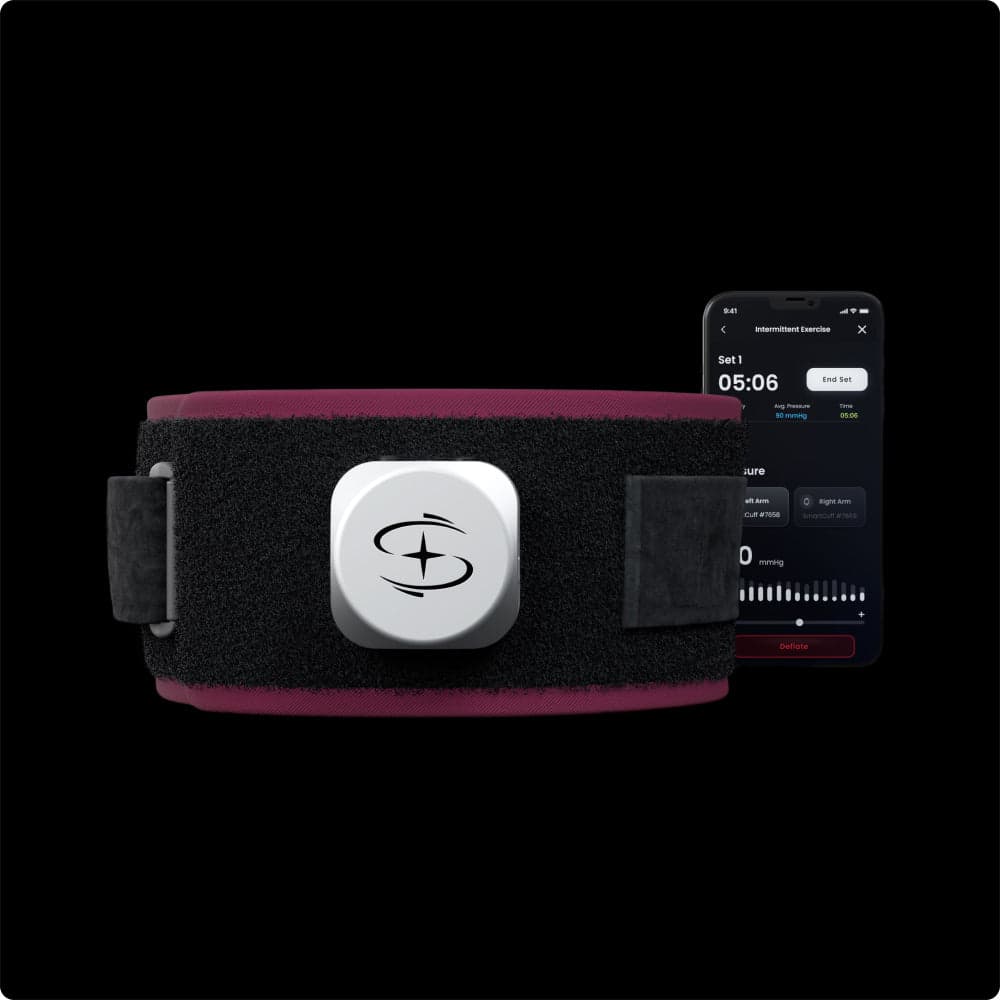
SmartCuffs 4.0
4.0/ 5.0
LOP Calibration Accuracy & Reproducibility4.5
Mid-Set Auto-Adjustment Performance5.0
Safety Mechanism Integrity5.0
Build Quality & Durability3.0
App & Connectivity2.5
Value for Clinical Rehab Use4.5
FDA Clearance / Registration — Could not be verified from available sources. Status not asserted; clinical buyers should confirm directly with the manufacturer before procurement.Hardcoded 80% LOP Safety CapBattery Life (5x competitor claim) — My 3-4 sessions per charge is consistent with a strong battery, but the unspecified competitor baseline means the 5x multiplier itself is unverified.
Bottom line: SmartCuffs 4.0 is the only sub-$500 BFR system that auto-corrects pressure as muscle swells mid-set, holding within 6 mmHg of target LOP, though a dated USB-Mini port and 5-minute bilateral calibration are real trade-offs.
Price: ~$499Discounted Price

At a glance

Price tiers$499 one pair / $899 two pairs / $1,699 Clinical Set
Mid-set auto-adjustmentYes - held within 6 mmHg of target through final reps
Safety ceilingHardcoded 80% LOP cap plus physical emergency stop
Calibration time~5 min bilateral legs / 2-3 min arms (real-world)
ChargingUSB-Mini, ~30 min charge, 3-4 sessions per charge
SizesS, M, L, XL

Rating breakdown

LOP Calibration Accuracy & Reproducibility
4.5
Mid-Set Auto-Adjustment Performance
5.0
Safety Mechanism Integrity
5.0
Build Quality & Durability
3.0
App & Connectivity
2.5
Value for Clinical Rehab Use
4.5

Pros & cons

Pros

  • Auto-adjusts pressure in real time as muscle swells mid-set, holding within 6 mmHg of target through the final reps
  • Hardcoded 80% LOP ceiling that cannot be disabled, plus a physical emergency-stop button on the cuff
  • Session-to-session calibration held within 3 to 5 mmHg on the same rested limb across six weeks
  • Single-chamber pneumatic bladder distributes pressure evenly across the cuff width
  • Firm non-stretch cuff body that does not loosen as the limb expands under load
  • Four cuff sizes (S, M, L, XL) that fit atrophied or edematous post-surgical limbs the older three-size range struggled with
  • Runs a full calibration and BFR session from onboard controls with no phone or tablet required
  • Pump and Doppler integrated into the cuff body, so two cuff pairs can be driven from one app and there is no tubing to tangle

Cons

  • USB-Mini charging port is a 2010-era connector that will wear faster than USB-C in high-use settings
  • WiFi-enabled label oversells the app, which logs data and helps setup but cannot control inflation remotely during a set
  • Bilateral lower-extremity calibration takes about 5 minutes in practice, far longer than the brand's 10-second computation figure implies
  • Pump housing feels less premium than competitors at the same price, an aesthetic confidence issue rather than a functional one
  • FDA regulatory status is unconfirmed in available sources, so clinical buyers must verify before institutional procurement

Who is this for?

Best for

Post-surgical rehab patients who need a clinician-assignable BFR system that physically cannot over-occlude even with home self-application, and the physical therapists running ACL, total-knee, rotator-cuff, or quad-atrophy protocols where consistent mid-set LOP is clinically necessary. It also fits clinics wanting a sub-$2,000 multi-patient system with simultaneous bilateral cuff control, and supervised athletes who value accuracy over setup speed.

Skip if

Self-directed gym athletes who prioritize a 15-second setup, USB-C charging, and live phone control over mid-set pressure precision. It is also the wrong tool for institutional research protocols requiring published measurement-accuracy standards, where Delphi or Owens systems belong.

How I tested it

Six weeks, multiple patient populations, equipment purchased at retail — Clinically indicated LOP percentage per limb (70-75% legs post-op, 50% arms), 30-15-15-15 rep schemes at sub-20% 1RM, both clinic and home self-application

What didn't change: The 10-second calibration claim did not hold as a total-setup figure; real bilateral leg calibration took about 5 minutes, and the WiFi app could not control inflation remotely during a set despite the connectivity label.

The Moment That Made Me a Convert - And What It Actually Proves

Week three of a post-op rotation, I was watching a quad I could barely see fire under load. The patient was six weeks past ACL reconstruction, the atrophy visible even through his compression sleeve, the skin around the cuff still flaking from weeks of immobilization. I wrapped the SmartCuffs 4.0 around his thigh, hit calibrate, and watched the display climb to his personalized 80% limb occlusion pressure. Three sets of bodyweight squats later - quad firing, knee stable - he looked up and said the thing I wait to hear: that it actually felt like a workout. That moment is why these cuffs stay in my bag.
Here is what that scene proves, and what it does not. It does not prove the device 'works' in some vague motivational sense. It proves that automated, personalized LOP calibration produced a measurable, repeatable occlusion stimulus in a fragile post-surgical limb, on the very first session, with no adverse neurovascular event. That is a specific clinical claim, not a feeling. Limb occlusion pressure - the cuff pressure needed to fully stop arterial blood flow to a limb - is individual, and getting it right on an atrophied thigh is exactly where cheap bands fail.
This is not a lab bench test of one unit. It is a six-week clinical rotation across ACL reconstruction, post-total-knee, rotator cuff repair, quad atrophy, and runner's knee, with SmartCuffs 4.0 measured against SAGA the whole way. I bought every piece of equipment at retail. There were no manufacturer samples and there is no affiliate relationship with the brands named here. I have integrated BFR into my practice since 2018, and I will report the advantages and the legitimate complaints with equal weight.

What SmartCuffs 4.0 Is, In Plain Terms

SmartCuffs 4.0 is an automated pneumatic blood-flow-restriction cuff system. In plain English: it is a firm band that inflates by itself to squeeze a limb just enough to slow blood flow, so you can build muscle with light loads. The big architectural change from the Gen 3 model is that the air pump and the pulse-sensing electronics now live inside the cuff body itself, rather than in a separate box connected by tubing. In the box you get two cuffs, the integrated pumps, a USB-Mini charging cable, and a carrying case; the Clinical Set adds more cuff pairs and multi-device management.
It comes in four sizes - S, M, L, XL - which is one more than Gen 3 offered. That extra size genuinely matters: a thigh with significant surgical atrophy or a limb with edema sits at the outlier ends of the range, and a poorly sized cuff distributes pressure unevenly. The system runs three modes - Continuous (pressure held the whole set), Intermittent (pressure cycles on and off between sets), and Resting (occlusion without exercise, used for early recovery). It works on both legs and arms, and the app applies the right target automatically: 50% LOP for arms, 80% for legs.
On price, the brand lists three tiers: $499 for one pair, $899 for two pairs, and $1,699 for the Clinical Set. The brand markets the calibration as finding LOP 'in as little as 10 seconds' and the battery as five times the nearest wireless competitor with a sub-30-minute charge. I will hold both of those claims up to what I measured, because the 10-second figure in particular needs context before a buyer plans around it.

Why Limb Occlusion Pressure Has To Be Personalized
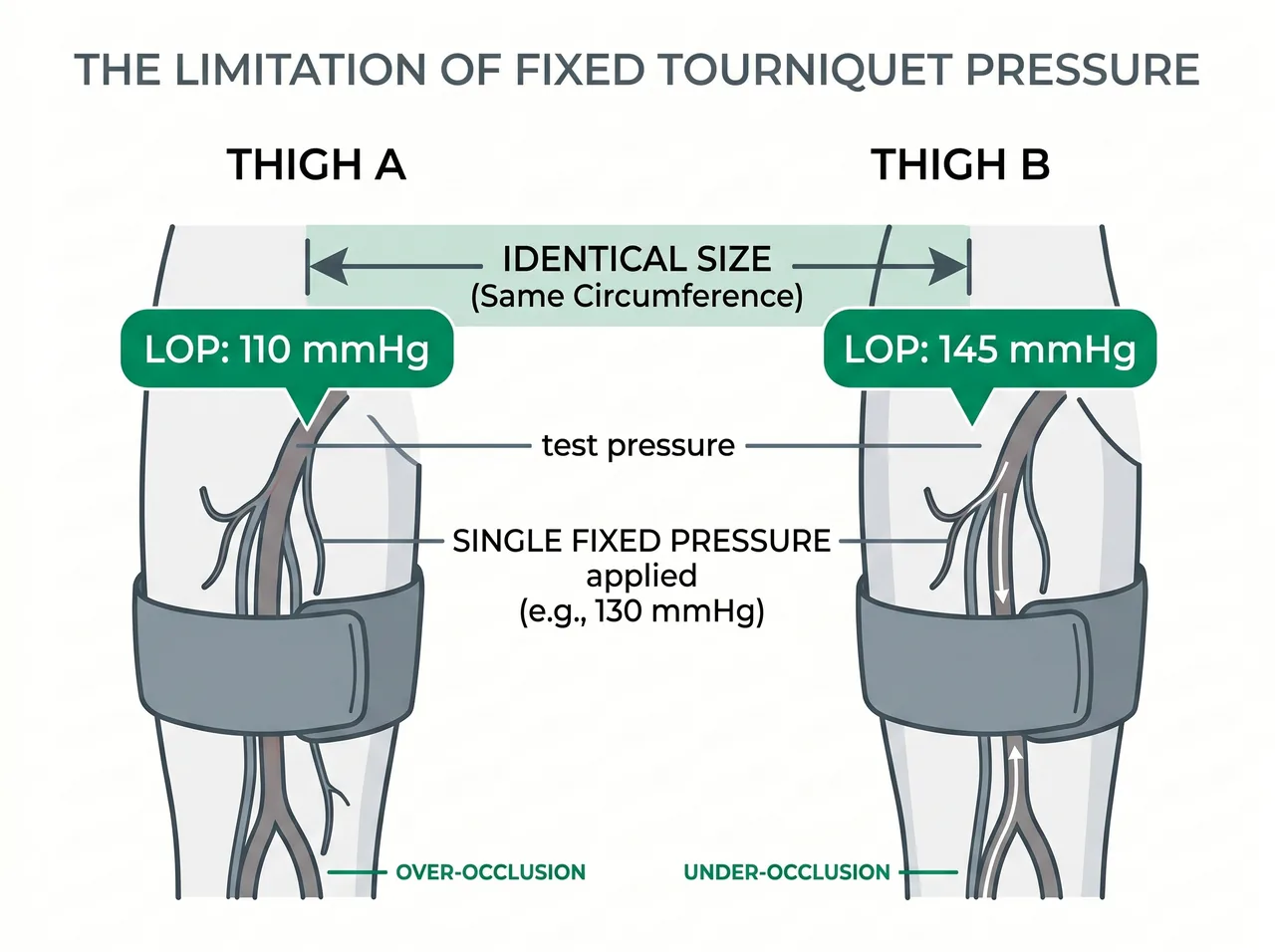
Limb occlusion pressure, or LOP, is the minimum cuff pressure needed to fully stop arterial blood flow to a limb at rest, measured in millimetres of mercury (mmHg). It is not a fixed number you can read off a chart. It shifts with limb circumference, tissue density, blood pressure, and even limb position. This is the single most important concept in BFR, so here it is as plainly as I can put it: wrapping a band 'to a 7 out of 10 tightness' is a guess, and LOP is a measurement.
Why the difference matters for safety: two patients with identical thigh circumferences can have LOP readings 30 to 40 mmHg apart. Apply one fixed pressure to both and you over-occlude the lower-LOP patient while giving the higher-LOP patient no real stimulus at all. That is why BFR uses a percentage of each person's own LOP - the clinical standard is 40 to 80% for legs and 40 to 50% for arms, never 100%. A personalized target is more reliable than subjective tightness, full stop.
The accuracy bar here is tight. The evidence on keeping cuff pressure within about 5 mmHg of target LOP is the clinical anchor for everything SmartCuffs 4.0 tries to do: real-time pressure monitoring exists precisely because drift of even a few mmHg compromises either safety or the training stimulus. A manual pump cannot chase that target while a patient is mid-rep. An automated loop can.
Two same-sized limbs with different LOP values showing why fixed pressure fails
Identical limb sizes can have LOP readings 30 to 40 mmHg apart, which is why personalization matters.

The Cuff Design Decisions That Change Every Rep
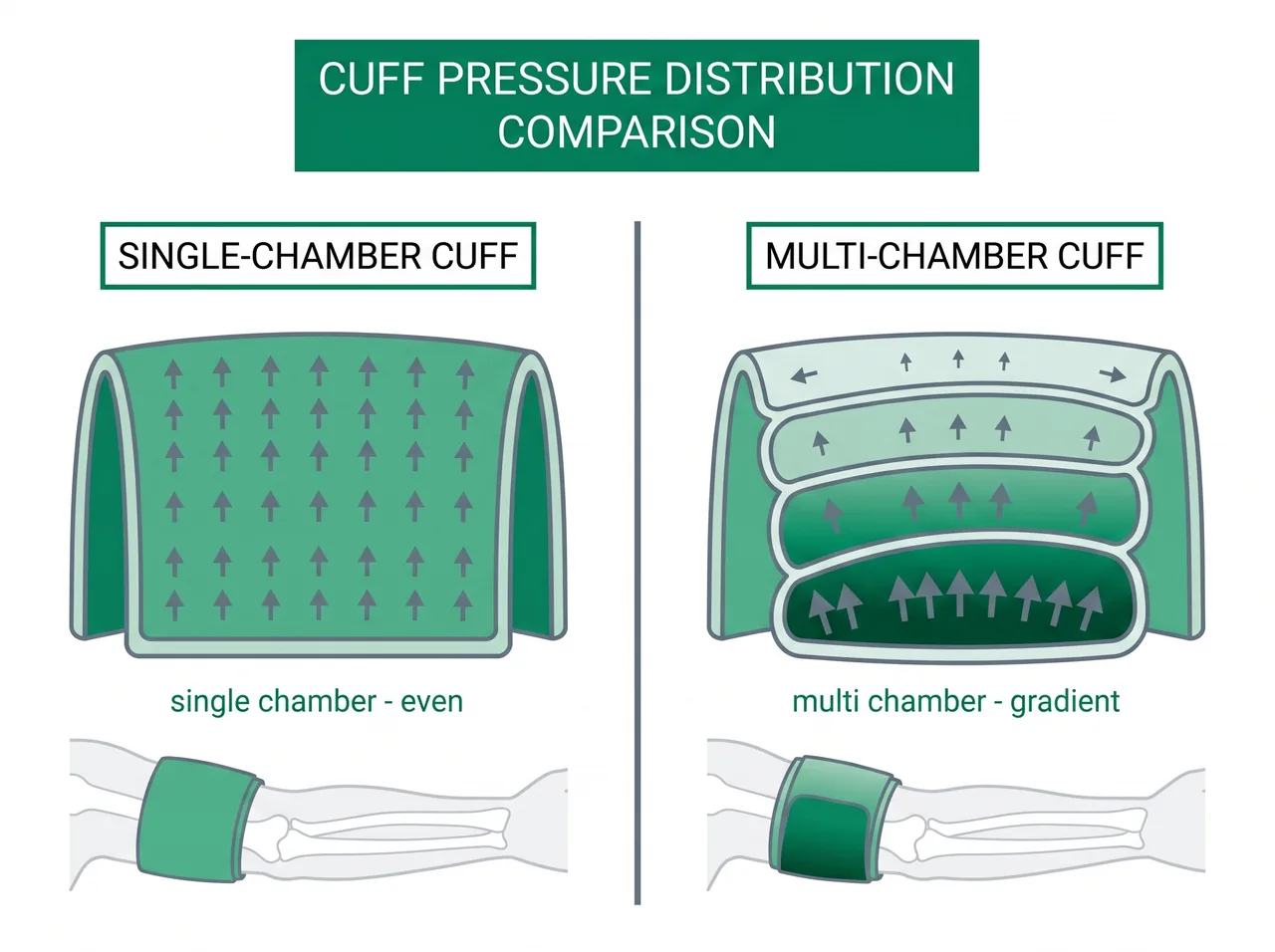
SmartCuffs 4.0 uses a single-chamber pneumatic bladder - one continuous air pocket that spreads pressure across the full width of the cuff. That sounds like a minor engineering footnote until you look at the alternative. The evidence on single- versus multi-chambered cuffs found that multi-chamber designs create pressure gradients across the cuff width, so one edge can be fully occluding while the other is not. In a post-surgical limb that is already irregular from swelling, atrophy, or hardware, that gradient is not just an efficacy problem; it concentrates pressure into focal neurovascular points.
The other design decision is the band material. It is firm and non-stretch on purpose. As a muscle swells during a working set, an elastic or semi-elastic band physically stretches with it and quietly loses occlusion - the user assumes pressure is holding while the cuff is actually loosening. The narrative review on semi-elastic pneumatic cuffs makes the non-stretch requirement explicit. In the rotator cuff case I ran, a patient tried to pull the arm cuff tighter than the calibrated setting and the band body simply did not deform. That is the behaviour you want.
These two mechanisms are complementary, not redundant. The non-stretch material prevents passive pressure loss from the band itself; the software auto-adjustment, which I will get to, corrects for any residual drift the hardware cannot. One is a structural fix, the other is an active correction, and together they close both failure modes that sink cheap bands.
Comparison of single-chamber even pressure versus multi-chamber pressure gradient across a cuff
A single continuous chamber spreads pressure evenly; multi-chamber designs can leave gradients.

Calibration, The 80% Cap, And Auto-Adjustment Mid-Set
Calibration works like this: the cuff inflates in steps, detects the point where it can no longer sense a pulse below the cuff, records that as LOP, then sets the operational target as a percentage of it. The brand's 'as little as 10 seconds' is the algorithm's computation time after the cuff is properly seated and the inflation sequence is running. In real clinical use, a bilateral lower-extremity setup ran about 5 minutes once I include cuff placement, patient positioning, and the inflation ramp. Two arms ran faster, around 2 to 3 minutes. Both numbers are true; the 10-second figure is just measuring a different thing. Before I trust any unit with a post-op patient, I run three consecutive calibrations on the same rested limb - SmartCuffs 4.0 held within 3 to 5 mmHg, which is my pass mark.
The 80% cap is the safety feature with real teeth. The device cannot inflate above 80% of measured LOP for any limb, no matter what a user types in, because the ceiling is hardcoded in the firmware rather than being a software preference someone can switch off. Above 80%, partial occlusion becomes complete occlusion - you lose the beneficial venous pooling and trade it for tissue ischemia risk. There is also a separate physical emergency-stop button on the cuff that dumps pressure on one press. Cap and stop button are two different mechanisms: one prevents over-inflation, the other ends any session instantly.
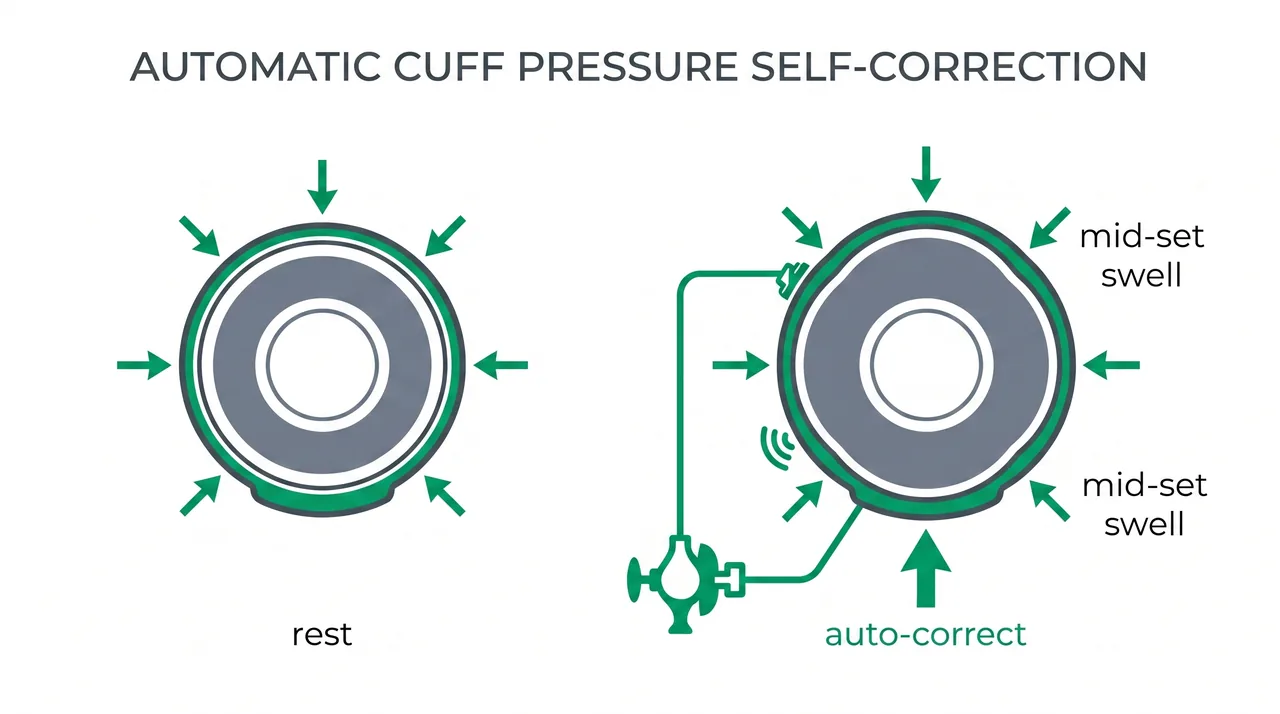
Now the feature no competitor at this price matches. That same ACL patient, by week ten, was loading 50% of his pre-op squat, and the SmartCuffs 4.0 auto-adjusted pressure mid-set as his quad swelled - something SAGA cannot do without manual intervention. Mechanically: when muscle swells under contraction, internal limb pressure rises and pushes back against the bladder, which quietly reduces net occlusion even as the cuff feels tighter. SmartCuffs detects that drift and adds compensatory inflation to hold target LOP. I verify it is working by glancing at the display around rep 15 to 18 of a 30-rep set; it should read within 5 to 8 mmHg of target, and across six weeks it did. Reps 20 through 30 are where the metabolic stress accumulates, so a cuff that loses occlusion there fails in the exact window that matters.
Diagram showing how the cuff detects pressure drift as muscle swells and adds inflation to hold target LOP
How real-time auto-adjustment keeps occlusion on target as the muscle swells through a working set.

Six Weeks Across Real Rehab Cases - What It Delivered
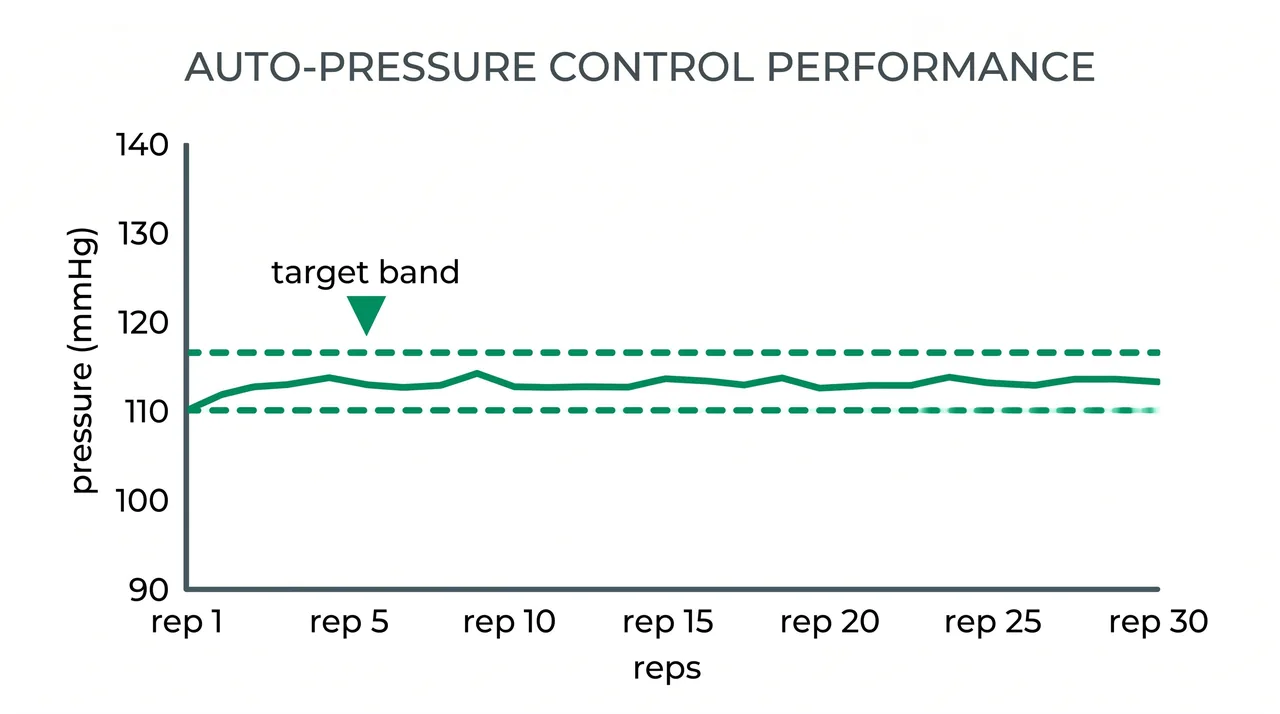
I ran SmartCuffs 4.0 at the clinically indicated percentage for each limb and condition, with all equipment bought at retail and no manufacturer input on protocol. In the ACL case (six weeks post-op, visible quad atrophy), I used 70% LOP - a conservative start for an acute limb - with a 30-15-15-15 rep scheme on bodyweight squats and terminal knee extensions. Calibration was consistent session over session, and during the extension sets, where I could see the quad swell, the pressure display held within 6 mmHg of target through the final reps. I selected the medium cuff for an atrophied thigh; the four-size range earned its keep there, because a three-size system would have forced a small and risked uneven pressure on an already irregular limb.
Weeks three and four covered post-total-knee and a rotator cuff repair. The knee patient ran 75% LOP, and the hardcoded 80% cap was the specific reason I felt comfortable clearing him to continue sessions at home between visits - he physically could not over-occlude with self-application. The shoulder case ran the upper-extremity standard of 50% LOP on bicep curls and external rotation, and the narrower arm cuffs sat evenly with no pressure asymmetry. The honest limitation showed up in the knee case: the 5-minute bilateral calibration was felt most when a patient fatigued quickly at rest, so I now calibrate seated and stable before any exercise begins.
Weeks five and six tested the non-clinical case: a runner's-knee patient who was pain-limited rather than load-limited, and a competitive runner doing off-season accessory work. For the self-directed athlete who has no DPT verifying pressure mid-set, the 80% cap and auto-adjustment remove two of the three big BFR error modes - over-occlusion and pressure drift - leaving only cuff placement as the remaining user error. That is genuinely reassuring for unsupervised lower-extremity work, where under-occlusion produces no training stimulus at all. It is also where SAGA's faster setup starts to look attractive, which is exactly the trade I unpack next.
Line chart of cuff pressure across a 30-rep set staying within 6 mmHg of the target band
Measured pressure held inside the target band through the final reps across the six-week rotation.

SmartCuffs 4.0 vs SAGA - The Comparison That Decides It

This is not a winner-versus-loser story. These are two systems tuned for different priorities, and the right answer depends entirely on who you are. SmartCuffs wins the one metric that decides clinical practice: holding accurate occlusion through an entire working set without anyone touching the device. SAGA wins essentially every convenience metric - charging, calibration speed, and app interface.
Be direct about the trade-offs. SAGA calibrates in around 15 seconds; SmartCuffs takes about 5 minutes for a bilateral lower-extremity setup. SAGA charges over USB-C; SmartCuffs uses USB-Mini, a connector that was standard around 2010 and that wears faster under frequent charging cycles. SAGA's Bluetooth app drives the device during a session; SmartCuffs' WiFi connection logs data and guides setup but cannot adjust pressure from across the room. None of those are reasons to reject SmartCuffs outright, but they are real, and a buyer should price them in. The pump housing also feels less premium than SAGA's - a confidence issue, not a functional failure, since the cuff material does its mechanical job.
The deciding question is auto-adjustment. SAGA does not compensate for muscle swelling mid-set; when the tissue expands, its effective occlusion can drop in the exact moment of peak metabolic demand, and the user has to re-inflate manually between sets. A BFR cuff that cannot hold its target percentage through the final reps is not delivering the protocol it promised. If you are a clinician, or a patient who cannot self-monitor, that makes auto-adjustment non-negotiable and SmartCuffs the answer. If you are a healthy athlete who can re-inflate between sets and values a clean 15-second setup, SAGA's convenience may genuinely be the better trade.

Regulatory Status And What Clinical Buyers Must Verify

Here is the honest answer to the question every clinician asks: I cannot confirm SmartCuffs 4.0's FDA regulatory status from the sources available to me. I will not assert clearance that I cannot verify. The device is documented in use by licensed DPTs in clinical settings, and the existence of a Clinical Set tier signals institutional adoption - but adoption is not the same as regulatory certification, and I want to keep that line bright.
The distinction matters more than most buyers realize, because there are three different legal statuses that get used loosely. FDA-cleared means a 510(k) review found the device substantially equivalent to an existing one. FDA-registered means the manufacturer is registered, which says nothing about the device itself. FDA-approved is a higher bar reserved for higher-risk devices. For a clinic documenting equipment standards for insurance billing or institutional compliance, those words are not interchangeable.
My advice is concrete: before any institutional procurement, verify the device's current and specific FDA status directly with the manufacturer, and get the answer in writing. For a home user buying a single pair under their own PT's supervision, this is a smaller concern - but for a facility committing to a $1,699 Clinical Set, it belongs near the top of the due-diligence list.

App, Connectivity, Durability, And Keeping The Cuffs Clean

The app does the useful basics well: it walks you through calibration, displays real-time pressure, logs sessions, and lets you pick among the three BFR modes. What it does not do is what the 'WiFi-enabled' label implies - you cannot control inflation or deflation from your phone during an active set. For a therapist hoping to adjust a patient's pressure from across the room, that gap is significant; for a home user standing at the device, it is barely noticeable. The saving grace is that you can run a full calibration and session from the onboard controls with no phone connected at all, which genuinely helps in a busy clinic where a tablet is never within reach.
On durability, six weeks is a short window for a hard claim, so I will scope it: no delamination, no seam separation, and no bladder asymmetry appeared across the rotation. The battery lasted 3 to 4 sessions per charge, consistent with the brand's general claim, and I never had to charge daily. The sub-30-minute charge time is a real operational advantage - you can top up between patients. The USB-Mini port is the legitimate worry. Under frequent clinical charging cycles, these connectors typically wear within 12 to 18 months, so I charge every 3 to 4 sessions rather than daily and use a right-angle adapter to reduce port stress. That is standard practice for any device still on this connector, not a workaround for a defect.
Cleaning is simple and worth getting right: wipe the cuff exterior with an alcohol wipe, never submerge the cuff, and keep the internal bladder away from water entirely. That keeps a shared-clinic cuff sanitary between patients without risking the pneumatic system.

Who Should Buy Which Tier - And Who Should Skip It
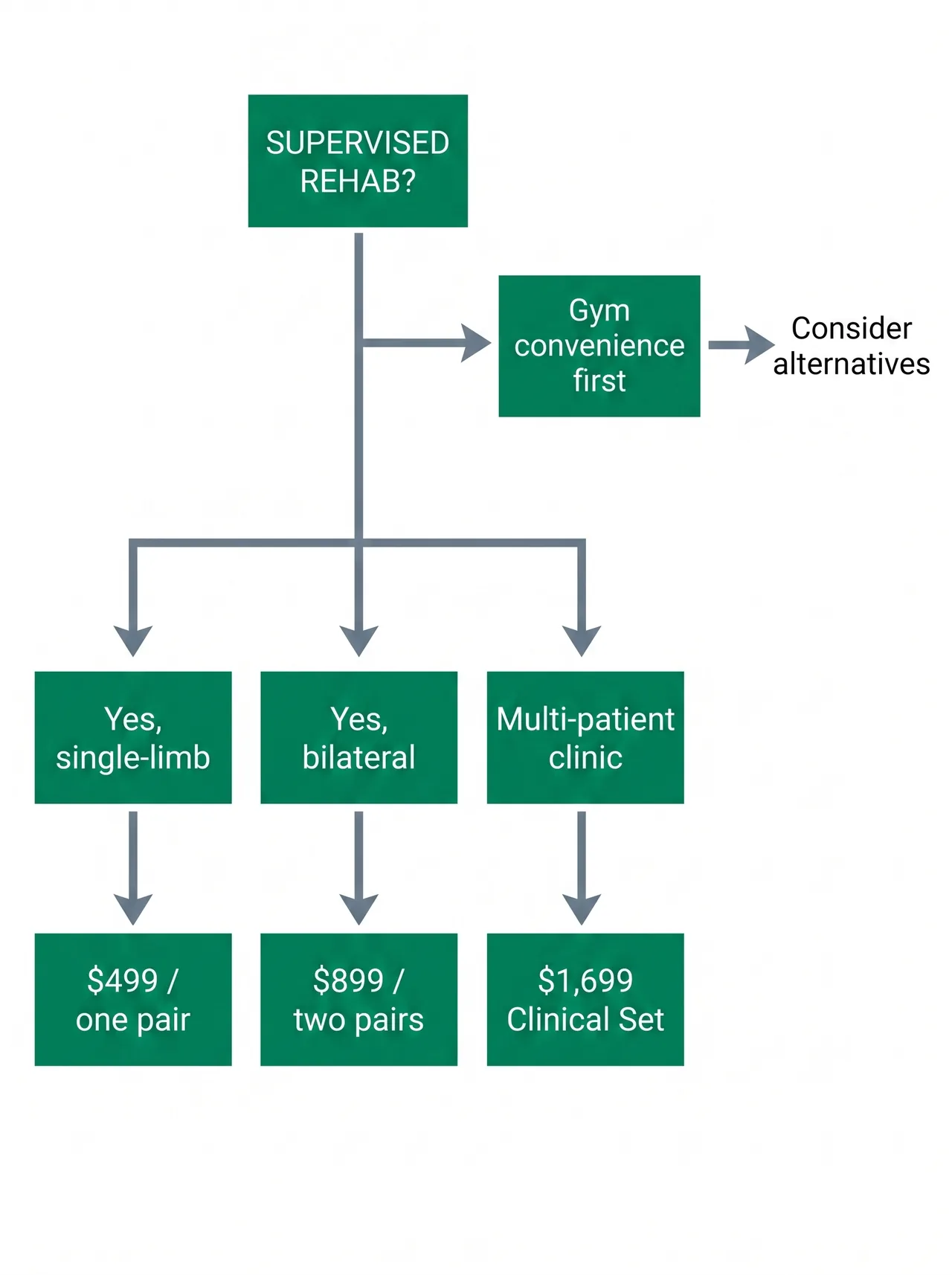
Match the tier to the use case, not the marketing. At $499, the single pair fits a home rehab patient under PT supervision, a solo athlete doing unilateral work, or a clinician evaluating the system before committing. Run three times a week for two years - a conservative post-surgical timeline - and that works out to roughly $1.60 per session. At $899, the two-pair kit saves about $99 over buying two singles and, more importantly, drives both pairs from one app, which is what makes it functionally different rather than merely cheaper - think bilateral leg work or simultaneous arm-and-leg protocols.
At $1,699, the Clinical Set is for a facility running multiple BFR patients per session, adding more cuff pairs across the S/M/L/XL range and multi-device management. The honest caveat: a clinic running 5 to 10 sessions a day stresses that USB-Mini port harder than any home user, so the charging-management routine is not optional at this tier. Against hospital-grade systems like Delphi or Owens that start around $3,000 to $5,000, SmartCuffs' argument is access and portability - bedside, gym, home visit - not raw measurement-precision equivalence.
Skip it if you are a self-directed gym athlete who values a 15-second setup and modern aesthetics over mid-set precision, if you need USB-C and live phone control during sessions, or if your protocol is unilateral static work where muscle swelling is minimal and auto-adjustment simply does not earn its calibration time. For that buyer, SAGA or Suji is the smarter spend. But for clinician-supervised, post-surgical rehab where the cuff must hold pressure while a quad swells with nobody touching it, this is the strongest value on the market.
Vertical decision tree matching buyer type to the correct SmartCuffs price tier
A quick decision path from your use case to the right configuration.

Ready to buy?

We earn a commission if you purchase — it does not affect our verdict.

See current price at SmartTools

SmartCuffs 4.0 vs SAGA BFR vs Suji

FeatureSmartToolsSAGA BFRSuji
Price (single pair)$499~$399-499~$499
Auto-adjustment mid-setYes - real-time pressure compensationNo - manual re-inflationNot documented
Calibration time (bilateral legs)~5 min real-world~15 seconds~30 seconds
80% LOP safety ceilingHardcoded in firmwarePercentage defaults, mechanism unspecified40-80% adjustable
Charging portUSB-MiniUSB-CUSB-C
App control during sessionData logging only, no live controlLive Bluetooth controlLive Bluetooth, AI protocols
Cuff chamber designSingle-chamber pneumaticPneumaticPneumatic with magnetic attachment
Run without appYes - full onboard controlsApp-dependentApp-dependent
Size optionsS, M, L, XLLimited sizingUpper/lower variants
Clinical multi-patient tierYes - $1,699 Clinical SetNoNo

Also tested

We tested these fitness equipment & rehab tech products in the same period. Here is why they did not make the cut.

SAGA SAGA BFR Cuffs

Best-in-class convenience for self-directed gym athletes. USB-C charging, roughly 15-second calibration, and a clean Bluetooth app make it the obvious pick when speed and modernity matter more than mid-set precision. Its core limitation - no auto-compensation as muscle swells - is a dealbreaker for clinical rehab but irrelevant for a healthy athlete doing fixed-rest supersets who can re-inflate between sets.

Suji Suji BFR Cuffs

The strongest challenger on app experience and protocol customization, with Bluetooth control, AI-personalized programs, and 40-80% compression in 5% steps. Cuff construction is high quality with a secure magnetic attachment, though the travel case is awkward to pack. At a similar price to SmartCuffs, it wins on UX and loses on clinical precision since no mid-set auto-adjustment is documented. Pick it for home performance use outside supervised rehab.

B Strong B Strong BFR System

A legitimate tool for one niche: high-movement athletic BFR where a rigid pneumatic cuff would restrict range of motion. The multi-bladder design does not fully occlude arterial flow at high pressures and does not calibrate to the patient's limb, which rules it out for reproducible rehab but suits a sprint or multi-directional sport athlete. It trades calibrated precision for freedom of movement.

Frequently asked questions

Are SmartCuffs 4.0 worth the money?

For post-surgical rehab and clinician-supervised protocols, yes. The auto-adjustment and the 80% LOP cap justify the premium for anyone who needs occlusion held accurately mid-set. Run three times a week for two years, the $499 pair works out to roughly $1.60 per session. For a gym athlete prioritizing setup speed and app polish, the value case is weaker and SAGA may suit you better.

How does SmartCuffs 4.0 compare to SAGA BFR cuffs?

SmartCuffs 4.0 auto-adjusts pressure as muscle swells mid-set; in my testing it held within 6 mmHg of target through the final reps, while SAGA requires manual re-inflation between sets. SAGA wins on calibration speed (about 15 seconds versus my 5-minute bilateral setup), USB-C charging, and live app control. They sit in the same price tier, so the choice comes down to whether you need clinical precision or convenience.

What is the difference between SmartCuffs 3.0 and 4.0?

The 4.0 integrates the pump and pulse sensor directly into the cuff body, eliminating the separate pump unit of the 3.0 and removing the tubing that tangled in multi-patient settings. It also enables simultaneous control of two cuff pairs from one app and adds a fourth size, XL, on top of the existing S, M, and L. For single-limb protocols, the 3.0 remains clinically equivalent.

How long does SmartCuffs 4.0 take to calibrate?

In real-world use, a bilateral lower-extremity calibration took me about 5 minutes including cuff placement, positioning, and the inflation ramp; two arms ran 2 to 3 minutes. The brand's 10-second figure refers only to the algorithm's computation time once the cuff is seated and inflating, not the full setup. Both are technically accurate, but the 10-second number is misleading without that context.

Can you use SmartCuffs 4.0 on legs and arms?

Yes, it is designed for both. The upper-extremity cuffs are narrower and the lower-extremity cuffs are wider, and the app automatically applies 50% LOP for arms and 80% LOP for legs with no manual percentage adjustment required. The four-size range accommodates a wide spread of limb circumferences for both upper and lower body work.

Does SmartCuffs 4.0 have a safety shut-off?

It has two distinct mechanisms. The first is a hardcoded 80% LOP ceiling: the device cannot inflate above 80% of your measured LOP for any limb, and that limit is set in firmware so a user cannot disable it. The second is a physical emergency-stop button on the cuff that triggers immediate deflation in one press. The cap prevents over-inflation; the button ends any session instantly.

What is limb occlusion pressure in BFR training?

Limb occlusion pressure, or LOP, is the individual minimum cuff pressure in mmHg required to fully stop arterial blood flow to a limb at rest. It varies person to person with limb circumference, tissue composition, and blood pressure. BFR training uses a percentage of this personalized value - 40 to 80% for legs, 40 to 50% for arms - and never 100%, which is what makes percentage-based training safer than any fixed-pressure approach.

How tight should BFR cuffs be during exercise?

Never based on subjective feel. The clinical standard is 40 to 80% of measured limb occlusion pressure for legs and 40 to 50% for arms. A '7 out of 10 tightness' method used by elastic wraps does not reliably replicate that, because the same perceived tightness produces wildly different actual occlusion across different limbs. SmartCuffs auto-calculates the target and, crucially, maintains it as the muscle swells during the set.

Can you use SmartCuffs 4.0 without the app?

Yes. The cuff unit has onboard controls that run the LOP calibration and deliver a complete BFR session with no phone or tablet connected. The app adds session logging, protocol customization, and mode selection, but basic function does not require it. That onboard independence is a genuine advantage in a clinic where a tablet may not be immediately accessible.

Is SmartCuffs 4.0 cleared by regulators?

I could not confirm the device's specific regulatory status from the sources available to me, and I will not assert clearance I cannot verify. Clinical buyers should confirm the exact status - cleared, registered, or neither - directly with the manufacturer before institutional procurement, and get it in writing. Cleared and registered are different legal statuses with different implications for billing and compliance, so the distinction matters.
DJ

Written by

Dr. Jamie Sutton

Doctor of Physical Therapy (DPT). 8 years in orthopedic and sports rehab, specialising in post-surgical return-to-sport protocols. BFR integrated into clinical practice since 2018. All equipment purchased at retail and tested across a minimum six-week clinical rotation before publication.

MR

Reviewed by

Marcus Reid

Former product development consultant. Marcus Reid oversees editorial standards and quality review for all TrulyVetted content.