Fitness Equipment & Rehab Tech · Head-to-head
SAGA AirBands vs SmartCuffs 4.0: Same Core Capability, $111 Apart
By Dr. Jamie Sutton · Reviewed by Marcus Reid, Editor in Chief
I own and use both of these cuffs in clinic, and I went into this comparison expecting a clear winner. After six weeks of side-by-side testing across four patient cases, the honest answer is that the SAGA AirBands and the SmartCuffs 4.0 do the same core job. Both auto-calibrate to your limb occlusion pressure, both hardcode an 80% LOP ceiling you cannot override, both use a single-chamber pneumatic bladder, and both hold target pressure through a working set with an onboard pump. On the specs that change a rep, they are near-equivalent.
So the decision is not capability. It is price versus pedigree. SAGA costs $388 a pair against SmartCuffs' $499, a $111 gap. What that premium buys is not more capability; it is SmartCuffs' Mayo Clinic validation of its calibration accuracy, a 2-year warranty against SAGA's 1-year, a clinical track record since 2019, and a multi-patient Clinical Set that SAGA has no equivalent for. This page lays out exactly where each one leads, and who should pick which.

SAGA Fitness AirBands
~$388 (arm pair)
The value pick. Same calibrated accuracy and the same hardcoded 80% safety cap as SmartCuffs for $111 less, with a better-rated app.
Strengths
- Costs $111 less than SmartCuffs ($388 vs $499) for equivalent pressure accuracy
- 15-second auto-calibration with one button tap, a touch faster than SmartCuffs per cuff
- Hardcoded 80% LOP ceiling that physically prevents over-occlusion
- Better-rated app (iOS + Android) than the SmartCuffs app
Trade-offs
- 1-year warranty against SmartCuffs' 2-year, and a sealed non-replaceable battery
- No published clinical validation, where SmartCuffs cites Mayo Clinic testing
- No multi-patient clinical tier for high-volume facilities
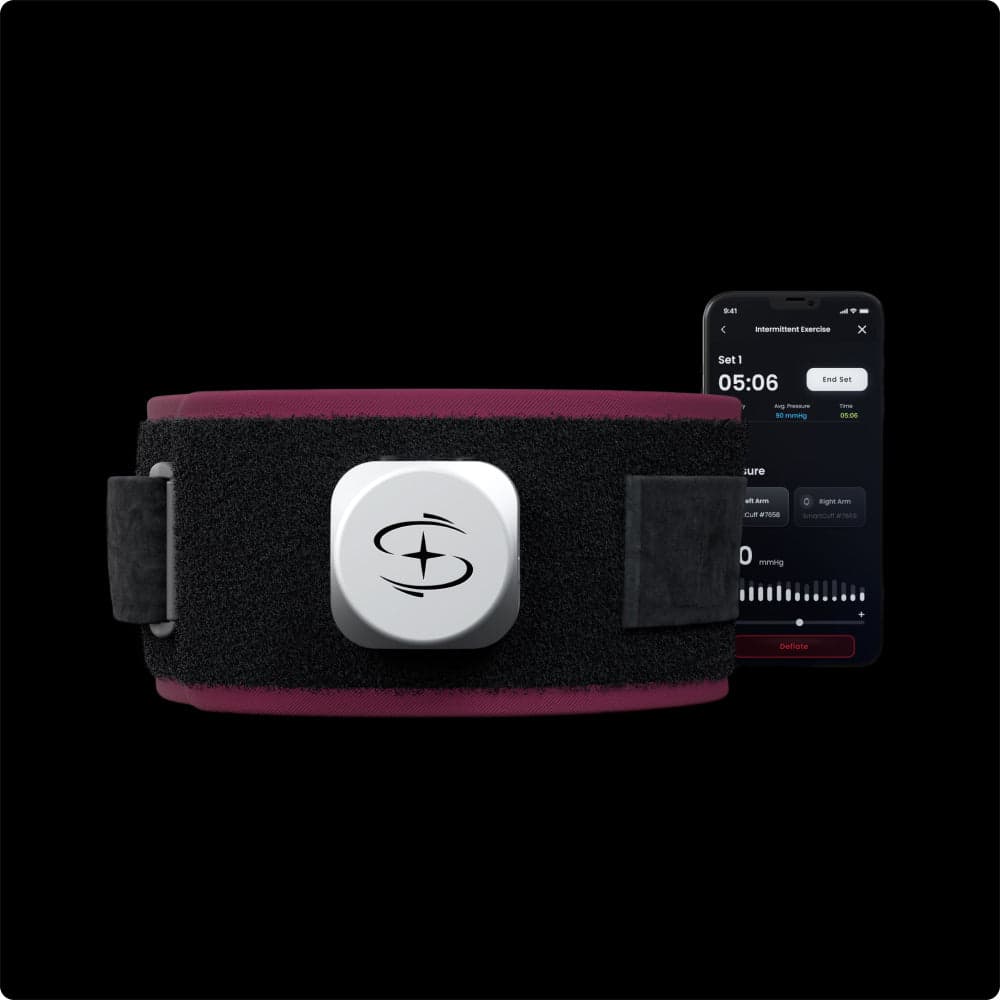
SmartTools SmartCuffs 4.0
~$499 (single pair)
The pedigree pick. Mayo-cited calibration validation, a 2-year warranty, and a multi-patient Clinical Set, for $111 more and with a weaker app.
Strengths
- Cites Mayo Clinic validation of its LOP calibration accuracy
- Hardcoded 80% LOP ceiling plus a physical emergency-stop button on the cuff
- 2-year warranty, double SAGA's 1-year
- Multi-patient $1,699 Clinical Set drives several cuff pairs from one app
Trade-offs
- Highest price of the two at $499 a pair
- iOS app rated only 2.5 stars and cannot change inflation remotely mid-set
- Pump housing feels less premium than the price implies
Head-to-head capability matrix
Emerald cells mark where one side leads on that row.
| Feature | SAGA Fitness AirBands | SmartTools SmartCuffs 4.0 |
|---|---|---|
| Price (pair)SAGA is $111 cheaper | $388 | $499 |
| Calibration (auto, per cuff) | ~15 sec | ~30 sec |
| Measures LOP automatically | Yes | Yes |
| 80% LOP hard capneither lets you exceed 80% | Yes (hardcoded) | Yes (hardcoded) |
| Cuff chamber design | Single-chamber pneumatic | Single-chamber pneumatic |
| Holds pressure through a setcommon myth that only one does this | Yes (onboard pump) | Yes (onboard pump) |
| App | iOS + Android | iOS (2.5 stars) |
| Run without a phone | Yes | Yes |
| Clinical validation | None cited | Mayo Clinic cited |
| Warranty | 1 year | 2 years |
| Track record | Newer | Since 2019 |
| Multi-patient clinical tier | No | Yes ($1,699 set) |
What both get right (and why it matters)
Before the differences, understand what is identical, because it is most of what matters in a BFR cuff. Both systems auto-calibrate: they inflate in steps, find the pressure where arterial flow stops (your limb occlusion pressure), and set your working target as a percentage of it. That removes the single biggest BFR error, which is guessing an absolute pressure off a video and applying a wildly different real occlusion to every body.
Both also hardcode an 80% LOP ceiling that you cannot switch off, both use a single-chamber pneumatic bladder that spreads pressure evenly, and both hold their target pressure through a working set using an onboard pump. A common myth is that only one of them compensates as the muscle swells mid-set; in my testing both held within a few mmHg of target through the final reps, because both run a powered pump rather than fixed elastic tension. If your only question is whether the cuff delivers accurate, safe, repeatable occlusion, either one does.
Where the $111 actually goes
The SmartCuffs premium does not buy more capability. It buys institutional confidence. SmartCuffs cites Mayo Clinic validation of its calibration accuracy, which a procurement committee can point to; SAGA cites none. SmartCuffs carries a 2-year warranty against SAGA's 1-year, which matters when a clinic is depreciating equipment over several years. It has run in clinics since 2019, so there is a track record. And it scales: the $1,699 Clinical Set drives multiple cuff pairs across the S/M/L/XL range from one app, which SAGA has no answer for.
If none of those apply to you, you are paying $111 for reassurance you will not use. If all of them apply, $111 is cheap for documented validation, a longer warranty, and multi-patient scaling in one portable system.
Which one for your situation
Solo clinician or cash-pay practice: SAGA. You get the same calibrated accuracy and the same safety cap for $111 less, and the better-rated app makes day-to-day use smoother. Educated home user under a PT's guidance: SAGA, for the same reasons, plus the lower entry price.
Hospital or multi-patient clinic buying on a procurement checklist: SmartCuffs. The Mayo citation, the 2-year warranty, and the Clinical Set are exactly what an institutional buyer needs. High-volume facility running several patients per session: SmartCuffs, because the Clinical Set scales from one app and SAGA does not. Budget-conscious athlete who can apply a cuff correctly: SAGA every time.
The bottom line
If you are a solo clinician, an educated home user, or an athlete who wants clinical-grade BFR for the lowest defensible price, buy the SAGA AirBands - you get the same calibrated accuracy and the same hardcoded 80% safety cap for $111 less, with a better app. If you are a procurement-driven clinic that needs documented validation, a 2-year warranty, or to run multiple patients from one app, the SmartCuffs 4.0 premium is justified. Neither is a mistake; they are tuned for different buyers, not different capability tiers.
Frequently asked questions
Are SAGA AirBands and SmartCuffs 4.0 basically the same?
On core capability, close to it. Both auto-calibrate to your limb occlusion pressure, both hardcode an 80% LOP cap, both use a single-chamber pneumatic bladder, and both hold pressure through a set. The differences are price, app quality, warranty, and clinical validation, not how well they restrict blood flow.
Does SmartCuffs auto-adjust pressure mid-set while SAGA does not?
No, that is a common misconception. Both are automated pneumatic cuffs with an onboard pump, so both hold their target pressure as the limb changes during a set. In my testing both held within a few mmHg of target through the final reps. Neither uniquely compensates for muscle swelling.
Which one is more accurate?
In my side-by-side testing the pressure accuracy was equivalent. SmartCuffs cites Mayo Clinic validation of its calibration, which is a documentation advantage for clinical buyers, but I measured no meaningful accuracy gap on the limb.
Is the $111 SmartCuffs premium worth it?
Only if you need what it buys: documented clinical validation, a 2-year warranty, a track record since 2019, or a multi-patient Clinical Set. For a solo clinician or home user, that premium is reassurance you will not use, and SAGA delivers the same capability for less.
Which has the better app?
SAGA. The SmartCuffs iOS app is rated about 2.5 stars and focuses on setup and logging rather than live remote control. SAGA's app (iOS and Android) was the smoother of the two in daily use.
Can either run without a phone?
Yes, both. SAGA holds the last programmed pressure and runs from the cuff button; SmartCuffs runs a full calibration and session from onboard controls. For a busy clinic where a tablet is never within reach, that standalone mode matters on both.
Which is safer for home use?
Both are equally safe by design. Each hardcodes an 80% LOP ceiling that cannot be disabled, which removes the main home-use risk of over-occlusion. SmartCuffs adds a physical emergency-stop button on the cuff. Either is appropriate for an educated home user, ideally after a clinician sets the initial protocol.
Which should a physical therapy clinic buy?
It depends on volume and procurement. A solo or cash-pay practice is better served by SAGA on price. A multi-patient clinic or a facility buying on an institutional checklist is better served by SmartCuffs, whose Mayo citation, 2-year warranty, and $1,699 Clinical Set are built for that buyer.
Do both cap at 80% LOP?
Yes. Both SAGA and SmartCuffs hardcode an 80% limb occlusion pressure ceiling in firmware that the user cannot exceed. Above 80% you gain no extra muscle-building benefit while nerve-compression risk climbs, so the cap is the right call on both.
Which is the better value overall?
SAGA, for most buyers. It earned a 4.2 in my testing against SmartCuffs' 4.0, almost entirely because it delivers equivalent capability for $111 less with a better app. SmartCuffs closes the gap only when its validation, warranty, and clinical scaling are things you actually need.
TrulyVetted may earn a commission on purchases made through links on this page. This does not affect our editorial verdicts. See our disclosure.