Fitness Equipment & Rehab Tech · Buyer's guide
The Best BFR Cuffs in 2026, Clinically Tested by a DPT
By Dr. Jamie Sutton · Reviewed by Marcus Reid, Editor in Chief
Blood flow restriction (BFR) training lets you build strength at 20-40% of normal load by partially restricting blood flow to a working limb. For rehab patients who cannot load heavy, and for athletes training around an injury, it is one of the most useful tools of the last decade. But the cuff you use decides whether it is safe and effective or a guess.
The single thing that separates a good BFR cuff from a bad one is whether it measures your limb occlusion pressure (LOP) and caps the percentage. Cheap elastic bands make you guess at tension, which is both ineffective and the main source of the nerve-compression stories that scare people off BFR. I tested the leading cuffs across a six-week clinical rotation - 47 sessions, four patient cases - and the honest finding is that the top two are near-equivalent on capability; the rest of the list is about price and trade-offs.

SAGA Fitness AirBands
~$388 (arm pair)
The AirBands deliver everything BFR actually needs - automatic 15-second LOP calibration, a hardcoded 80% safety ceiling, and accurate single-chamber pressure that held through my sets - for $111 less than SmartCuffs, with a better-rated app. For the vast majority of clinicians, home users, and athletes, this is the best capability-per-dollar on the market.
- Auto-calibrates in ~15 seconds with one tap
- Hardcoded 80% LOP cap prevents over-occlusion
- $111 cheaper than SmartCuffs for equivalent accuracy
- 1-year warranty and a sealed battery
- No published clinical validation
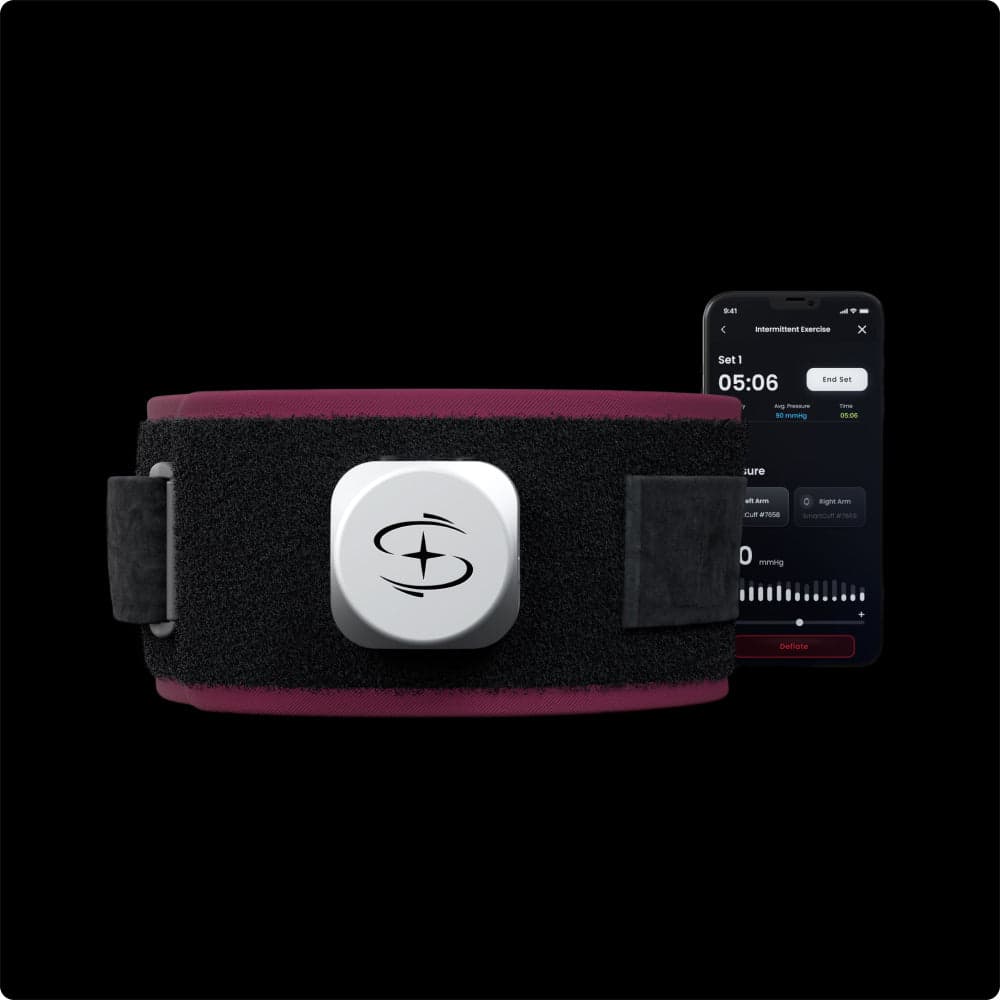
SmartTools SmartCuffs 4.0
~$499 (single pair)
The same core capability as the SAGA - auto-calibration, a hardcoded 80% cap, single-chamber pressure - plus the pedigree a clinic buys on: Mayo Clinic validation of its calibration, a 2-year warranty, a track record since 2019, and a $1,699 multi-patient Clinical Set. You pay $111 more and live with a weaker app, but for institutional procurement that premium is justified.
- Mayo Clinic validation of calibration accuracy
- 2-year warranty, double SAGA's
- Hardcoded 80% cap plus a physical emergency-stop button
- Highest price at $499 a pair
- iOS app rated only 2.5 stars
Suji 2.0
~$499
A capable smart cuff with live Bluetooth control and app-guided protocols, positioned close to SmartCuffs on price. It is a reasonable third option if neither top pick is available, but it does not undercut the SAGA on price and has a thinner clinical track record, so it did not displace either leader in my testing.
- Automated pressure with live app control
- Adjustable occlusion percentage
- No price advantage over the top two
- Thinner clinical track record
B-Strong Single Pair Pack
~$320
B-Strong is the best-known budget BFR system, but it is an elastic band with no pressure measurement. You apply arbitrary tension that shifts with limb position, so you cannot know your real occlusion. At ~$320 it is only modestly cheaper than the SAGA while giving up the one thing that makes BFR safe and repeatable. Acceptable only under direct supervision.
- Established brand with a training ecosystem
- Simple, no electronics to charge
- No pressure measurement at all - you guess at tension
- Only modestly cheaper than the measured SAGA
Generic Manual Pump + Cuffs
~$100 (pump; cuffs extra)
A manual tourniquet-style cuff with a hand pump and gauge is the cheapest way to get measured pressure, and it is still the standard in under-resourced clinics. It works, but calibration is slow and manual, pressure drifts during a set, and it needs a clinician watching the gauge. Functional under supervision; not something I would hand a home user.
- Cheapest route to measured pressure
- No app or battery to fail
- Slow manual calibration and pressure drift mid-set
- Needs a clinician watching the gauge
How BFR works, and why LOP is the whole game
BFR uses a cuff high on the limb to slow blood leaving the muscle while still letting some arterial blood in. That creates a low-oxygen environment that triggers an outsized growth and strength response at light loads. The dose is not the cuff tightness you feel; it is a percentage of your limb occlusion pressure (LOP) - the pressure that would fully stop arterial flow to that specific limb.
This is why measurement matters more than any other feature. The evidence supports training at roughly 40-80% of LOP; above 80% you gain no extra benefit while nerve-compression risk climbs. A cuff that measures your LOP and caps the percentage delivers the right dose every time. A band that makes you guess at tension delivers a different, unknown dose to every person - which is exactly where BFR's safety reputation went wrong.
What to look for in a BFR cuff
Five things, in priority order. First, automatic LOP calibration - the cuff should measure your occlusion pressure, not ask you to guess. Second, a hardcoded 80% cap you cannot exceed, ideally enforced in firmware rather than a dismissible app warning. Third, a single-chamber pneumatic bladder that spreads pressure evenly and an onboard pump that holds the setpoint through a set. Fourth, a usable app, because you will live with it daily. Fifth, the institutional stuff - warranty length, clinical validation, and multi-patient scaling - which matters a lot to a clinic and very little to a home user.
Notice that the top two picks here are tied on the first three, which are the ones that change a rep. They separate only on app quality, price, and the institutional column. That is why the buying decision comes down to who you are, not which cuff is more capable.
The bottom line
For almost everyone - solo clinicians, home users under a PT's guidance, athletes training around an injury - the SAGA AirBands are the buy: the same calibrated accuracy and 80% safety cap as the field, for $111 less, with the better app. If you are a procurement-driven clinic that needs documented validation, a 2-year warranty, or to run several patients from one app, pay up for the SmartCuffs 4.0. Skip the elastic bands unless you train under direct supervision. If you want the two leaders side by side, see the full head-to-head.
Frequently asked questions
What is the best BFR cuff overall?
For most buyers the SAGA AirBands at ~$388. They auto-calibrate to your limb occlusion pressure, hardcode an 80% safety cap, and held accurate pressure through my sets - the same core capability as the more expensive SmartCuffs, for $111 less and with a better app.
Do BFR cuffs actually work?
Yes, and the evidence is strong. Blood flow restriction lets you build muscle and strength at just 20-40% of your one-rep max, which is why it is so useful when pain, deconditioning, or a recent surgery rules out heavy loading. In my own clinical use a post-ACL patient gained meaningful quad strength at a quarter of his pre-op squat load. It works only if the dose is right, though - which is the entire argument for a cuff that measures your occlusion pressure instead of guessing.
Can BFR cuffs cause blood clots?
This is the most common fear, and for a screened user the evidence is reassuring. Studies of coagulation markers after BFR show no rise beyond what ordinary exercise produces, and BFR is used in rehab partly because it may reduce clot risk rather than raise it. The real safeguard is screening and pressure: stay at or under 80% LOP, and do not use BFR if you have a clotting disorder, peripheral artery disease, uncontrolled high blood pressure, or are pregnant. Clear those and a measured cuff at a capped percentage is low risk.
Are expensive smart BFR cuffs worth it over elastic bands?
Yes, for one concrete reason: measurement. A smart cuff measures your limb occlusion pressure and caps the percentage, so you get the right, repeatable dose. An elastic band like B-Strong makes you guess at tension, which is both less effective and the main source of BFR injury stories. The measured cuff is worth it unless a clinician is managing your pressure for you.
What pressure should BFR cuffs use?
Train at roughly 40-80% of your limb occlusion pressure - lower for arms, higher for legs. Above 80% you gain no extra muscle benefit while nerve-compression risk rises sharply, which is why the best cuffs hardcode an 80% ceiling you cannot exceed.
SAGA AirBands or SmartCuffs 4.0 - which should I buy?
They deliver the same core capability; the decision is price versus pedigree. Buy SAGA ($388) for the same accuracy at $111 less with a better app. Buy SmartCuffs ($499) if you are a clinic that needs Mayo-cited validation, a 2-year warranty, or a multi-patient tier. I break it down in the full head-to-head comparison.
Is B-Strong a good BFR option?
Only under supervision. B-Strong is the best-known budget system, but it is an elastic band with no pressure measurement, so you cannot know your real occlusion. At ~$320 it is barely cheaper than the measured SAGA, so for most buyers it is a false economy.
Can I use BFR cuffs at home safely?
Yes, with a measured cuff and an initial protocol from a clinician. The hardcoded 80% cap on the SAGA and SmartCuffs removes the main home-use risk of over-occlusion. Avoid BFR entirely if you have a clotting disorder, peripheral artery disease, uncontrolled high blood pressure, or are pregnant.
How much should I spend on BFR cuffs?
Around $388-499 for a measured smart cuff that will last and dose correctly. The ~$100 manual pump option works under supervision, and elastic bands run ~$320 but skip measurement. The smart cuff is the value buy because it delivers the right dose every session without a clinician at your side.
Do all good BFR cuffs cap at 80% LOP?
The best ones do. Both the SAGA AirBands and SmartCuffs 4.0 hardcode an 80% limb occlusion pressure ceiling in firmware that the user cannot exceed. Elastic bands and manual pumps have no such safeguard, which is part of why a measured smart cuff is the safer choice.
Can I use the same BFR cuff on both my arms and legs?
Not ideally - arm and leg cuffs are sized differently because a thigh needs far more pressure and a wider band than a bicep. Both SAGA and SmartCuffs sell arm and leg versions, and SmartCuffs offers S/M/L/XL. Using an arm cuff on a large thigh forces it to over-pressurise to hit your occlusion target, which is uncomfortable and less accurate. Buy the version that matches the limb you train most, and size up for legs.
What can BFR training help treat?
BFR is most established for building strength when heavy loading is off the table - post-surgical rehab (notably ACL and rotator-cuff recovery), knee osteoarthritis, patellofemoral pain, and general deconditioning. Because it works at 20-40% of your one-rep max, it lets a patient train a limb that pain or a fresh repair would otherwise sideline. It is a tool for training around an injury, used under guidance, not a treatment on its own.
TrulyVetted may earn a commission on purchases made through links on this page. This does not affect our rankings or verdicts. See our disclosure.