BetterAlt · Fitness Nutrition

BetterAlt Shilajit Sticks Disclose 400mg Per Serving - But the 75% Fulvic Claim Is a Red Flag

By Ryan Calloway·Reviewed by Marcus Reid, Editor in ChiefLast tested July 1, 2026

Four-week single-subject contest-prep protocol at one stick per day. I ran a full label-math teardown (400mg disclosed against total stick weight to establish the shilajit-to-honey ratio), a cost-per-day and cost-per-mg-of-actual-shilajit calculation, a resin-baseline taste calibration (checking whether earthy bitterness breaks through the honey), a fulvic-plausibility audit against the ~15-20% authentic range, and a search for a product-specific certificate of analysis. Compared against Pür Altai pure resin and standardized PrimaVie extract.

Competitive natural bodybuilder (WNBF), NASM-CPT.

TrulyVetted earns a commission on qualifying purchases at no extra cost to you. Editorial policy

GOLD+ Shilajit Honey Sticks
3.5/ 5.0
Label Transparency & Dose Disclosure3.5
Testing & Purity Verification2.5
Convenience & Adherence4.8
Taste & Palatability4.5
Value (Per Day and Per mg Actual Shilajit)3.5
Evidence-to-Product Transfer2.5
screened by an outside lab claimed, no COA shown75% fulvic claim implausible400mg per-serving disclosure
Bottom line: BetterAlt's honey sticks give you an honest 400mg-per-stick disclosure at ~$1.00/day, but an implausible 75% fulvic claim and no product-specific COA leave real potency unproven.
Price: ~$29.99 / 30 sticksDiscounted Price

At a glance

Disclosed shilajit per stick400mg (brand claim)
Fulvic acid claim75% (implausible red flag)
Product-specific COANot shown
Price$29.99 / 30 sticks (~$1.00/day, $0.85 autoship)
FormatFlavored acacia-honey + saffron stick
SourcingHimalayan (brand claim)

Rating breakdown

Label Transparency & Dose Disclosure
3.5
Testing & Purity Verification
2.5
Convenience & Adherence
4.8
Taste & Palatability
4.5
Value (Per Day and Per mg Actual Shilajit)
3.5
Evidence-to-Product Transfer
2.5

Pros & cons

Pros

  • Discloses 400mg of shilajit per stick - a genuine per-serving figure that beats hidden 3000mg-front blends
  • Honey plus Kashmiri saffron makes it far more palatable than raw resin, with earthy notes still detectable
  • No mess, no measuring, no sticky resin - you actually take it daily, which is where most resin plans fail
  • Cheaper per day than pure resin: ~$1.00 a stick, or about $0.85 on autoship
  • Portable single-serving format fits a busy training or prep schedule
  • Squeeze it directly or stir into coffee or tea - flexible dosing without a scale

Cons

  • Advertises 75% fulvic acid, which is implausible for authentic shilajit (real material runs ~15-20%)
  • Claims third-party testing but shows no product-specific certificate of analysis with numbers to verify heavy metals or fulvic content
  • The 400mg figure and the clinical evidence use different material - the trials ran on standardized extract, not honey sticks
  • You pay partly for honey and convenience, so raw shilajit mass per dollar is lower than resin

Who is this for?

Best for

Busy natural bodybuilders, trainers, and serious gym-goers who want a portable, non-stimulant shilajit they will actually take daily, and who value taste and convenience over squeezing raw resin from a jar. It suits budget-conscious buyers because it runs cheaper per day than pure resin.

Skip if

Skip it if you need documented, lab-verified potency for competition paperwork, want the most shilajit mass per dollar, or are convinced by the 75% fulvic claim - which you should discount, not chase.

How I tested it

4 weeks of daily use during WNBF contest prep — One stick each morning timed with fasted cardio, held away from iron/zinc/magnesium dosing, calibrated against years of pure Himalayan resin use as a taste baseline

What didn't change: No acute stimulant effect and no readable product-specific COA surfaced; the disclosed 400mg and the 75% fulvic figure remained brand claims I could not independently confirm, and the energy effect was subtle and subjective, not measurable.

I Ripped One Open at 10 Weeks Out - Then Did the Label Math

By week three of my deepest cut I was standing in my kitchen at 5 a.m., pre-workout already mixed, 10 weeks out from my WNBF show, and my energy was flat on the floor. My scalp itched from the diet-and-water stress, my hands were cold, and the last thing I wanted was to scrape a sticky dab of resin onto a spoon. So I tore open a BetterAlt GOLD+ honey stick, squeezed it into my mouth, chased it with black coffee, and was out the door in 30 seconds. No measuring. No goo on the counter.
But the question nagged me the whole drive to the gym: is there actually enough shilajit in this thing to matter?
I have used pure Himalayan resin for years. I know what real shilajit tastes like, how a therapeutic dab feels, and how easy it is for a flavored product to hide a weak dose behind sweetness. That baseline is the whole reason I bought these sticks at retail and ran them through a full four-week prep block.
Here is my honest thesis up front. BetterAlt is the convenient, cheaper, better-tasting way to take shilajit, and it discloses 400mg per stick when most blends bury the real number behind a giant front-label figure. But it over-claims in exactly the spots where it should reassure you: an implausible fulvic percentage, a testing claim with no readable lab report, and reviews that are heavily curated. The rest of this review is me showing my work.

How Much Shilajit Is Actually in Each Stick
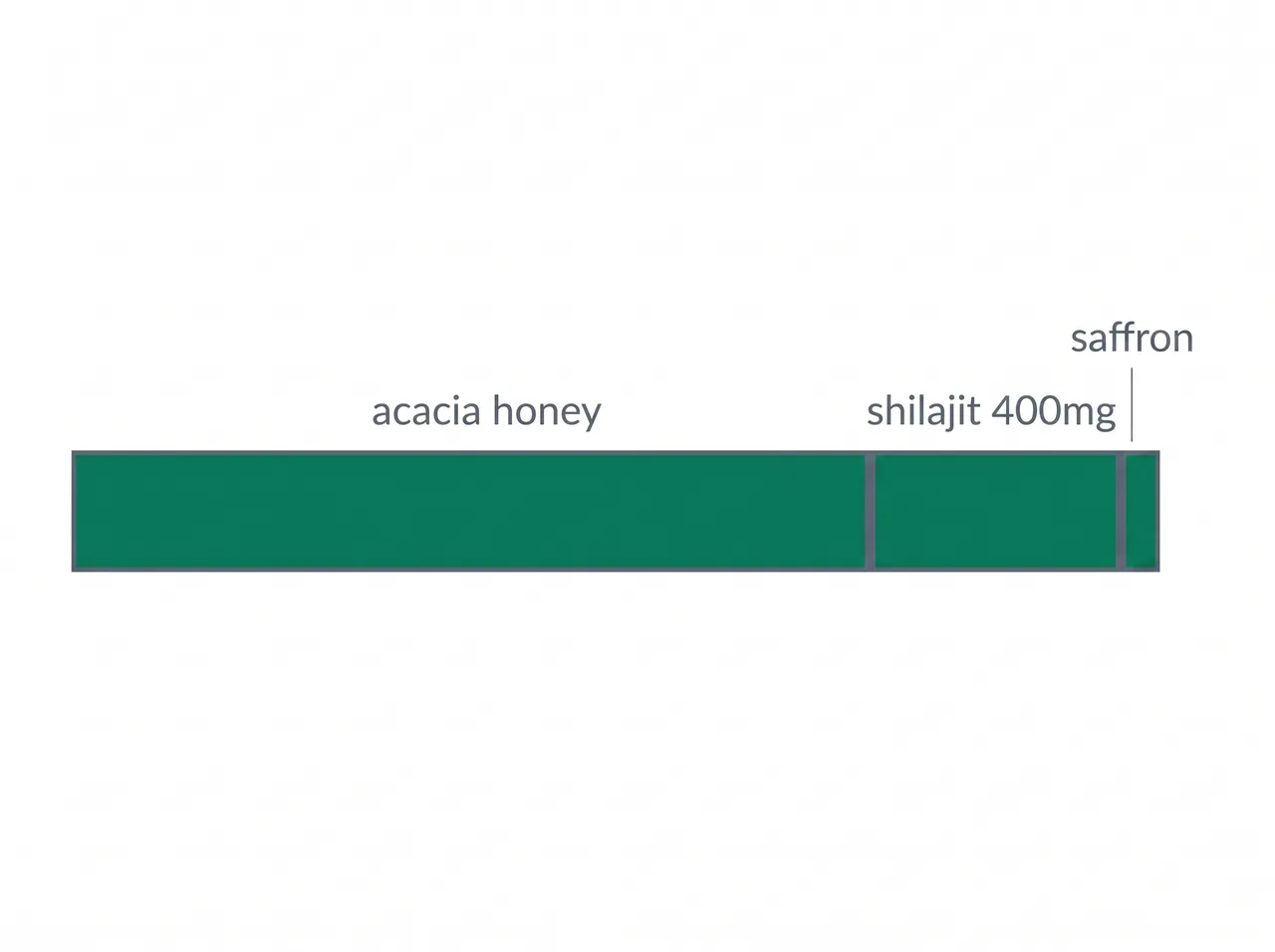
Here is the practical answer: each stick contains a stated 400mg of shilajit. BetterAlt frames it as the same 400mg you would get from one serving of resin. That is a real per-serving disclosure, and it deserves credit.
Now the label-math teardown, which is a method you can run on any shilajit product. Take the disclosed active dose - 400mg. Then look at the total stick weight. The base is acacia honey with a little Kashmiri saffron and flavor. By weight, the honey is the majority of the stick and the shilajit is a minority. That sounds alarming, but it is normal for a honey stick. You are buying a small active dose suspended in a sweet carrier. The point is that you should know the ratio, not be surprised by it.
Compare that to the pattern I fight constantly: a gummy or blend that screams 3000mg on the front and, once you read the panel, holds maybe 100mg of actual shilajit. BetterAlt's stated 400mg is genuinely better behavior than that. You get a number to hold them to.
Here is the honest caveat. That 400mg is a brand claim, not an independent assay. No product-specific certificate of analysis confirms the figure with a lab number. Skeptics reasonably suspect some blends hold only 5 to 10 percent real shilajit; that suspicion applies to unlabeled blends generally, and BetterAlt at least states a figure. But a stated figure is a promise, not proof.
Bar showing a honey stick mostly acacia honey with a small 400mg shilajit portion
The label-math teardown: 400mg of active shilajit sits inside a mostly-honey base.

The Fulvic Acid Problem - Why 75 Percent Is a Red Flag, Not a Feature
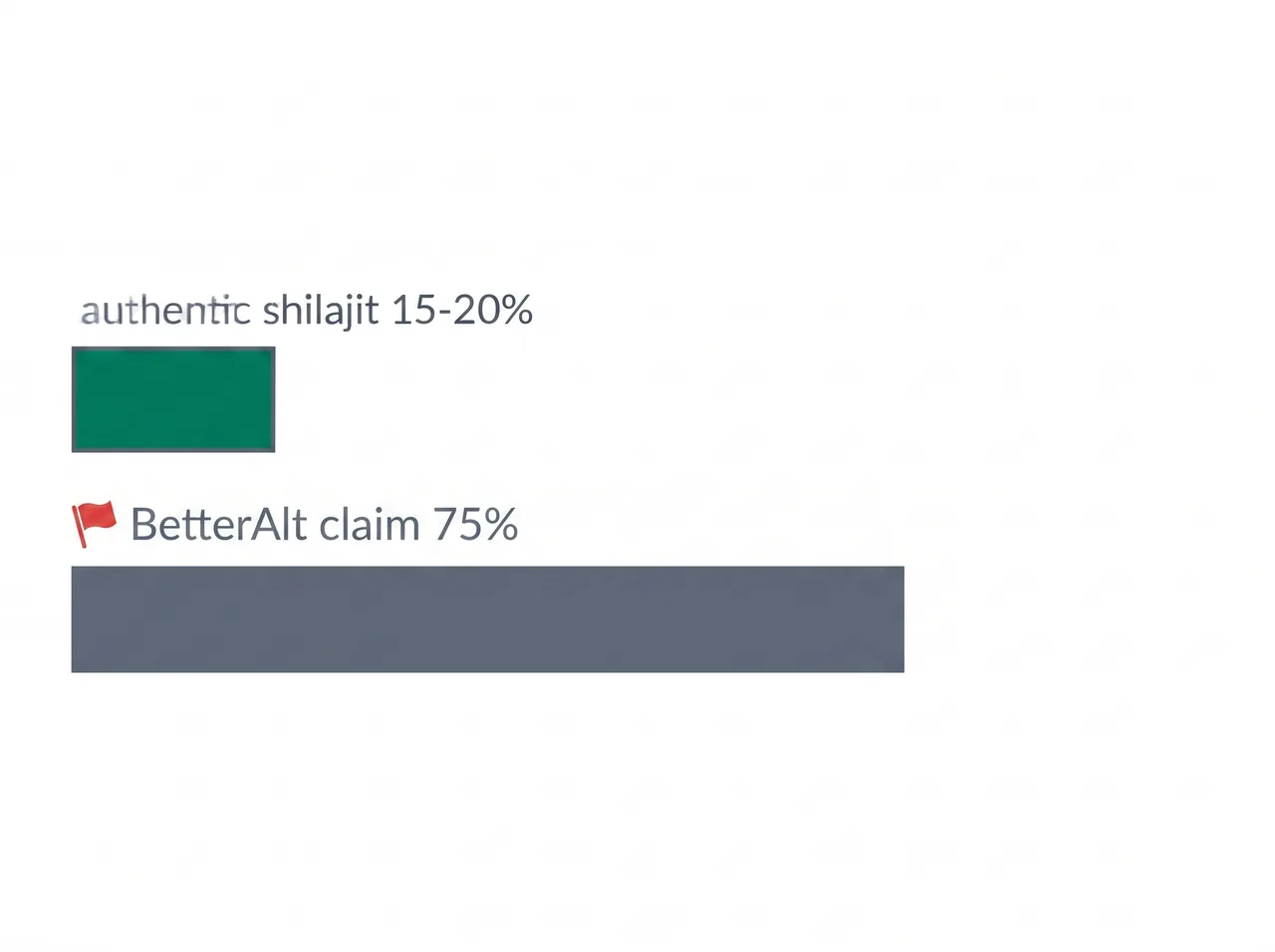
BetterAlt advertises 75% fulvic acid. In plain terms, fulvic acid is the compound in shilajit that helps shuttle minerals into cells and supports cellular energy. More of it sounds like more potency. It is not that simple.
Authentic, high-altitude shilajit typically contains only about 15 to 20 percent fulvic acid. A 75 percent figure is implausibly high. My rule, which you can apply to every shilajit product you evaluate, is simple: treat any fulvic claim above roughly 20 percent as a discount signal, not a selling point. An inflated number usually points to low-altitude, synthetic, or dated material - the opposite of premium.
The mechanism itself is real. Fulvic acid does play a role in mineral transport and cellular bioenergetics. But in the human trials, the benefit tracked to a standardized extract with a controlled composition, not to a raw percentage boast on a label. A big number is not the same as a proven, standardized dose. When I see 75 percent, my resin-baseline instinct is to be more careful, not more impressed.
Chart contrasting authentic shilajit fulvic range with the implausible 75% claim
Authentic shilajit runs 15-20% fulvic; a 75% claim reads as a red flag.

Are They Actually screened by an outside lab - and Where Is the COA
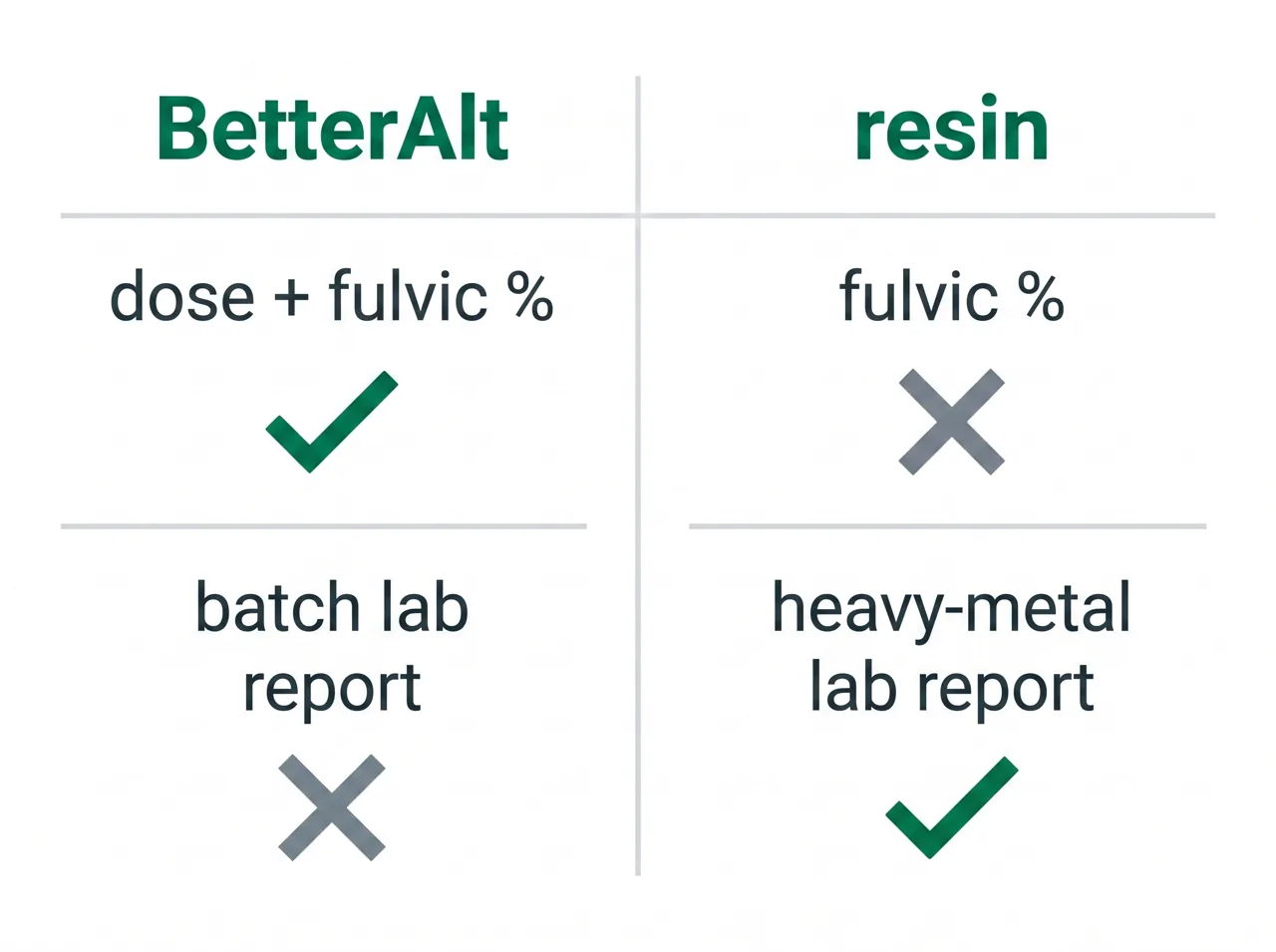
The product page states the sticks are screened by an outside lab for heavy metals, aflatoxin, fulvic content, and nutritionals. That is the right list of things to test. The problem is what I could not find: a product-specific certificate of analysis with actual numbers. A certificate of analysis, or COA, is the lab document that shows the measured parts-per-million of lead, arsenic, and mercury for a specific batch. Without one you can read, the testing claim stays an unverified promise.
This is where the comparison gets interesting, and it is the spine of this whole category. BetterAlt prints a big dose and a big (implausible) fulvic percentage but shows no readable batch COA. Pür does the reverse: it discloses no fulvic figure at all, yet it posts a real independent heavy-metal batch report. Neither approach ties a per-serving fulvic gram to a lab-verified number. So potency stays unproven both ways - you are choosing which kind of transparency you value.
Why does this matter more here than in most supplement categories? Because shilajit, when it is not properly purified, can carry lead, arsenic, and mercury. That contamination risk is documented and real. When the raw material itself can be toxic, a readable COA is not a nice-to-have; it is the single most important document a brand can show you. BetterAlt not showing one is the biggest gap in my scorecard.
My practical move: I would contact the brand and ask for a batch-specific report before committing to autoship. If they send one with real numbers, my testing-and-purity score goes up. Until then, I treat it as claimed but not shown.
Two-column comparison of what BetterAlt shows versus what the resin shows
The transparency inversion: each product shows what the other one hides.

Taste Test - Does the Honey Mask a Weak Dose

Straight answer: the honey and saffron genuinely soften shilajit's bitter, tarry punch. The texture is thick and slightly grainy, like a rich flavored gel. It is worlds more pleasant than a raw resin dab.
Here is the calibration trick, and this is where my resin baseline earns its keep. A flavored shilajit product can do one of two things: mask a weak dose with pure sweetness, or carry a real dose where the earthy, mineral bitterness still breaks through the honey. In these sticks, that earthy finish is detectable underneath the sweetness. That is a good sign. It tells me the shilajit is not purely decorative - there is enough of it that the honey cannot fully bury it.
If you have never tasted raw resin, you will not have that reference point, so trust this: sweet honey up front, a distinct earthy tail on the finish. If a shilajit product tastes like nothing but candy, be suspicious. This one does not.

My 4-Week Contest-Prep Protocol, Week by Week
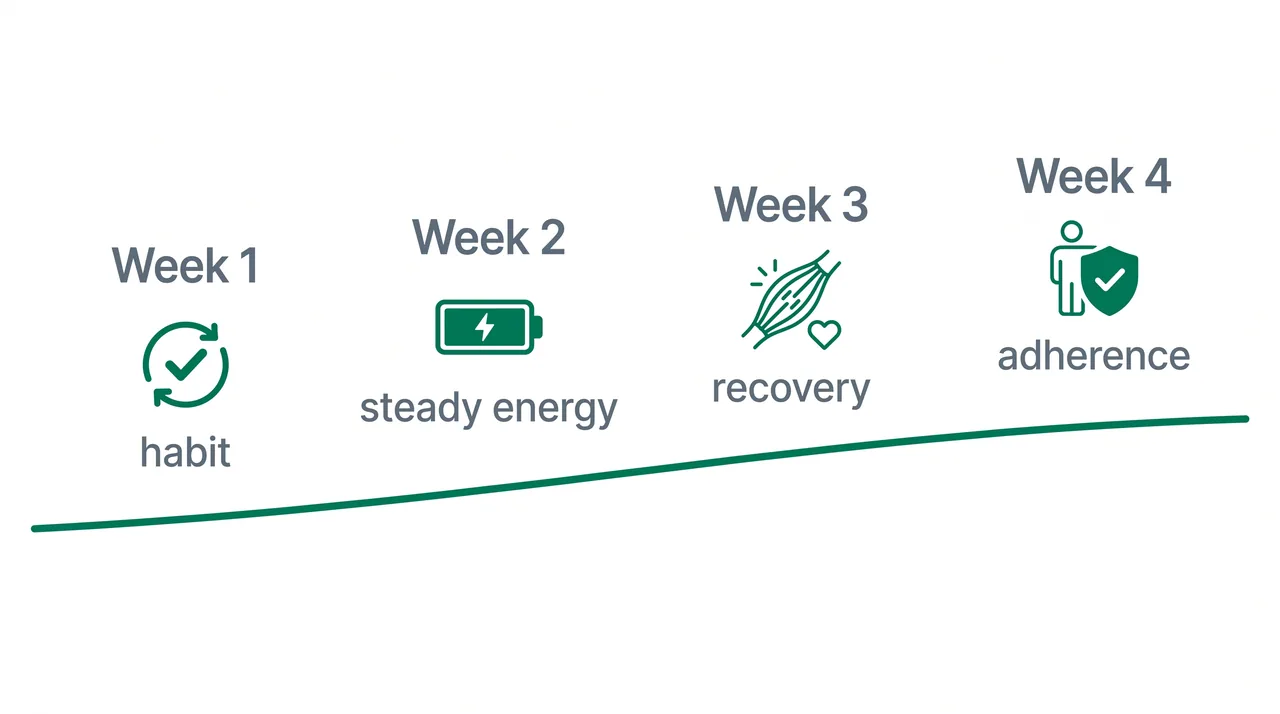
I ran one stick a day for a full four-week block during prep. Here is the honest, single-subject diary. It is unblinded and subjective - I am one athlete, not a trial - so read it as observation, not proof.
Week 1: One stick each morning, timed with my fasted cardio. I spent the week adapting to the taste and establishing the habit. No dramatic effect, and I want you to expect that. Shilajit is not a stimulant. If you are chasing a caffeine-style hit, this is the wrong product.
Week 2: This is where I noticed something subtle - a steadier baseline energy without the jitter or crash of another coffee. I stayed honest with myself about placebo here. When you buy something and want it to work, you feel what you expect. But the steadiness was consistent enough that I kept logging it.
Week 3: This was my deepest deficit, the same energy-drag point that had me tearing open that first stick at 5 a.m. My perceived recovery and mood steadiness held up better than a typical week-three of prep. Still subjective, still no lab markers, but worth noting because week three is usually my worst.
Week 4: The real verdict is about adherence. I took it every single day, and I did it because it was not messy. That is the format's genuine win. The most potent resin in the world does nothing if the mess makes you skip it.
One stacking tip that matters: I took the stick away from my iron, zinc, and magnesium doses. Fulvic acid binds minerals - that is chelation, where a compound grabs a mineral and can change how it absorbs. Keeping them a few hours apart avoids muddying either one.
Four-week timeline showing habit, steadier energy, recovery, then adherence
My single-subject prep diary: subtle, cumulative, and adherence-driven.

Do They Actually Work - For Energy, Recovery, and Testosterone

This is where I have to separate what shilajit can do from what these specific sticks are proven to do.
The human evidence for shilajit is genuinely interesting. In one randomized, placebo-controlled study, purified shilajit at 250mg twice daily for 90 days raised total testosterone, free testosterone, and DHEAS in healthy middle-aged men. In a sports-nutrition study, 500mg per day for 8 weeks helped retain maximal strength after fatigue and lowered a connective-tissue breakdown marker. Those are real, published, positive findings.
Now the caveat you cannot skip. Both of those studies used a standardized extract with a controlled, verified composition - not a honey stick and not a generic resin. A 400mg honey-stick dose is not proven to reproduce those results. It is also below the doses used in the trials, which ran 500mg per day and 250mg twice daily. So the correct read is: shilajit as a category has evidence; this particular delivery at this particular dose has not been shown to transfer it.
What I actually felt lines up with a modest, cumulative, non-stimulant effect: gradual steadiness rather than an acute buzz. That is consistent with fulvic-and-mineral bioenergetics working slowly over weeks. It is not consistent with a magic energy switch, and no honest reviewer should sell it to you that way.

Cost Analysis - Price Per Day AND Price Per mg of Actual Shilajit

The numbers: $29.99 for 30 sticks works out to about $1.00 per day. On autoship it drops to $25.49, roughly $0.85 per day. For comparison, pure resin like the Pür product runs about $1.30 per day. So on a straight per-day basis, these sticks are actually cheaper. That is a real, defensible value point.
But per-day price is a vanity metric, so here is the calc I actually run. Divide the price by the disclosed active shilajit - here, 400mg per stick - to get your true cost per mg of active material. Then run the exact same math on a resin's per-serving dose. When you do that, resin usually gives you more raw shilajit mass per dollar, because with the sticks you are also paying for honey and convenience.
So both things are true. The sticks win on cost per day and lose on cost per mg of raw active. Which matters depends on whether you value adherence and portability or maximum shilajit mass per dollar. For a busy athlete who would otherwise skip messy resin, the convenience premium is fair. For someone optimizing pure material cost, resin wins.

Honey Sticks vs Pure Resin - Which Should You Actually Buy
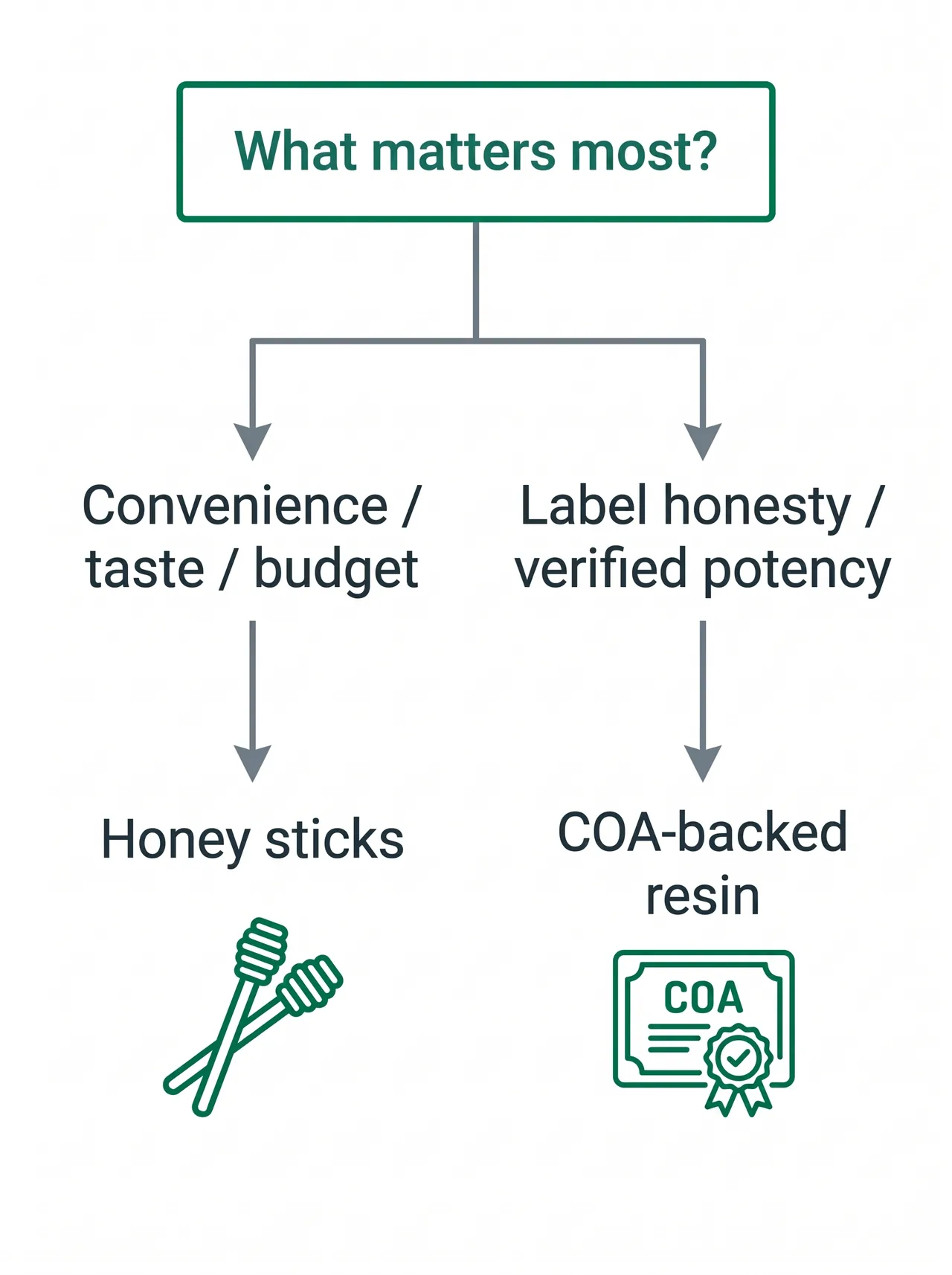
Think of this as a delivery-system choice, not a good-versus-bad fight.
The honey stick is pre-dosed, portable, palatable, and cheaper per day - but it shows no batch COA and makes an implausible fulvic claim. Pure resin is messy and self-dosed and carries the gold-standard reputation; the Pür version posts a real heavy-metal COA but discloses no fulvic figure at all. You can read Pür's full profile in our detailed breakdown of the COA-backed resin alternative.
Here is the decision in plain terms. If you want convenience, taste, and the lowest per-day cost, and you will realistically take it daily, the sticks earn a spot. If you want label honesty, standardized potency for competition documentation, or the most shilajit per dollar, go with a COA-backed standardized resin or extract and tolerate the mess.
The purist in me leans resin. The coach in me knows adherence beats theoretical purity you never actually take. That tension is the honest heart of this product.
Decision flowchart choosing honey sticks or resin based on priorities
A quick decision tree: convenience buyers versus verification buyers.

Dos and Don'ts, Plus Who Should Skip These

Do take it daily - the whole value is in the adherence the format enables. Do separate it from your iron, zinc, and magnesium by a few hours to avoid fulvic-mineral binding. Do start with one stick and take it slow. And do email the brand for a batch-specific lab report before you commit to a subscription.
Don't expect a stimulant hit; this is a slow, cumulative supplement. Don't treat the 75% fulvic claim as a potency selling point - discount it. And don't assume the word tested means a certificate of analysis you can actually read; here it does not, yet.
Who should skip these entirely: anyone who needs documented, verified potency for competition paperwork; anyone chasing maximum shilajit per dollar; and anyone on medication where mineral binding could matter, who should clear it with a physician first.

Ready to buy?

We earn a commission if you purchase — it does not affect our verdict.

See current price at BetterAlt

GOLD+ Shilajit Honey Sticks vs Pür Altai Resin vs Standardized PrimaVie

FeatureBetterAltPür Altai ResinStandardized PrimaVie
FormatFlavored honey stickRaw resin dabCapsule / standardized extract
Disclosed shilajit per serving400mg (brand claim)Self-dosedStandardized label dose
Fulvic % on label75% (implausible)None disclosedStandardized %
Product-specific COA shownNo (testing claimed only)Yes (independent heavy-metal batch)Typically yes
SourcingHimalayan (claim)AltaiVaries
Price per day~$1.00 ($0.85 autoship)~$1.30Varies
ConvenienceHigh (portable, no mess)Low (sticky, measured)High
TasteSweet honey + saffron, earthy finishBitter / tarryNeutral (capsule)
Best forConvenience / budget buyersVerified-safety puristsStandardized-potency buyers

Also tested

We tested these fitness nutrition products in the same period. Here is why they did not make the cut.

Pür Pür Altai Pure Resin

This is the label-honesty counterweight. It discloses no fulvic figure at all, which frustrated me at first, but it posts a real independent heavy-metal batch report - the exact document BetterAlt lacks. It is messier and self-dosed and runs about $1.30 a day. I reach for it when verified safety matters more than convenience.

Various (PrimaVie ingredient) Standardized PrimaVie Extract

This is the standardization champion and the benchmark the human trials actually used. When potency and documentation matter - competition paperwork, reproducible dosing - a standardized extract beats an unstandardized blend. It is the product I measure BetterAlt against for potency, not for convenience.

Assorted Generic 3000mg Front-Label Shilajit Blend

This is the cautionary contrast. A giant front number with buried actual content, often only a fraction of what the label implies. It is the exact pattern BetterAlt's honest 400mg disclosure improves on. I would skip these outright.

Frequently asked questions

How much shilajit is in each BetterAlt honey stick?

Each stick lists 400mg of shilajit, which BetterAlt frames as the same amount you would get from one serving of resin. That is a genuine per-serving disclosure and it beats blends that hide behind a big front-label number. I want you to know it is a brand-stated figure, though - no product-specific lab assay confirms it.

What is the fulvic acid content of these honey sticks?

BetterAlt advertises 75% fulvic acid, which is implausible - authentic shilajit typically runs only about 15 to 20 percent. I treat any claim above roughly 20 percent as a red flag pointing to low-altitude, synthetic, or dated material, not superior potency. Discount the number rather than celebrate it.

Are these shilajit honey sticks screened by an outside lab?

The page claims third-party testing for heavy metals, aflatoxin, fulvic content, and nutritionals, but I could not find a product-specific certificate of analysis with actual numbers, so I treat the testing as unverified. For comparison, the resin I benchmark against posts a readable independent heavy-metal batch report. I would ask the brand for a batch report before committing.

Do shilajit honey sticks work for testosterone?

In one randomized placebo-controlled study, purified shilajit at 250mg twice daily for 90 days raised testosterone and DHEAS in healthy middle-aged men. That trial used a standardized extract, not a 400mg honey stick, so those results are not proven to transfer to this product at this dose.

Are these honey sticks effective for energy?

In my four-week prep block, the effect was a gradual, caffeine-free steadiness rather than an acute stimulant hit. That fits shilajit's slow fulvic-and-mineral mechanism. If you are expecting a coffee-style jolt, this is the wrong product; the benefit, if real, builds over weeks.

How do you take BetterAlt shilajit honey sticks?

One stick per day, either squeezed straight into your mouth or stirred into a warm drink like coffee or tea. I took mine in the morning with my fasted cardio. Keep it a few hours away from mineral supplements to avoid binding.

Do shilajit honey sticks contain heavy metals?

Unpurified shilajit can carry lead, arsenic, and mercury, and BetterAlt's label lists no readable heavy-metal certificate of analysis to rule that out. This is exactly why a batch lab report matters more in this category than in most. I would not treat the testing claim as reassurance until you can see the numbers.

How long do these honey sticks take to work?

There is no same-day effect to expect. Both the 8-week strength-retention study and the 90-day hormone study ran for weeks, so expect gradual, cumulative effects over weeks, not immediate results. In my own block, the steadiness showed up around week two.

What is the price of these shilajit honey sticks?

$29.99 for 30 sticks works out to about $1.00 per day, or $25.49 on autoship (about $0.85 per day) - cheaper per day than pure resin at around $1.30 per day. Just remember you are also paying for honey, so cost per mg of raw shilajit favors resin.

Can you take shilajit honey sticks with other supplements?

Generally yes, but separate them from your iron, zinc, and magnesium doses because fulvic acid binds minerals, which is a process called chelation that can change how those minerals absorb. I kept mine a few hours apart from my mineral timing. If you are on medication, clear it with your physician first.

Related reviews & guides

Comparison

Shilajit Resin vs Honey Sticks: $1.30 Purity vs $1.00 Convenience, and Why Neither Proves Potency

I logged Pur resin ($1.30/day) against BetterAlt honey sticks ($1.00/day) for a full block. The format decision - plus why the 75% fulvic claim is a red flag.

Review

8 Weeks on Pür Shilajit: Eurofins Heavy-Metal Testing at $1.30/Day, No Fulvic Number, and Why That's the Point

At ~$39/30-day with a batch-matched Eurofins heavy-metal panel and Altai sourcing, Pür is the most defensible resin I tested on every knowable axis - but nobody, including Pür, can prove its potency.

Review

8 Weeks on ARMRA Colostrum: 0.5" Less Bloating, Fewer Sick Days, and Zero Disclosed IgG

ARMRA is a well-sourced, pleasant colostrum with real-but-modest immune benefits, but it refuses to publish a per-serving IgG figure - the one number that lets you check the dose - hedging behind a marketing percentage instead.

Review

12 Weeks of Contest Prep on WonderCow: Zero New Colds in the Back Half and a $1.08 Serving That Fights Warm Coffee

WonderCow is a genuinely filler-free, grass-fed colostrum at ~$1.08/serving that delivered real immune support across my prep, but it clumps badly in warm liquid and can't prove it beats ARMRA on IgG.

Review

8 Weeks on Thorne Creatine: +15 lb Squat, Zero GI Events, and a $52/Year Premium That Only Some Lifters Should Pay

For drug-tested natural athletes, Thorne Creatine's verified per-batch NSF Certified for Sport screening makes the $0.49/serving price legitimate insurance; for untested recreational lifters, it is the same molecule at nearly 4x the cost of bulk monohydrate.

RC

Written by

Ryan Calloway

Competitive natural bodybuilder (WNBF), NASM-CPT. 9 years of competition prep, coaches 12 clients. Every product is purchased at retail, tested across a full training block, and logged against the stated macros before a word is written.

MR

Reviewed by

Marcus Reid

Former product development consultant. Marcus Reid oversees editorial standards and quality review for all TrulyVetted content.